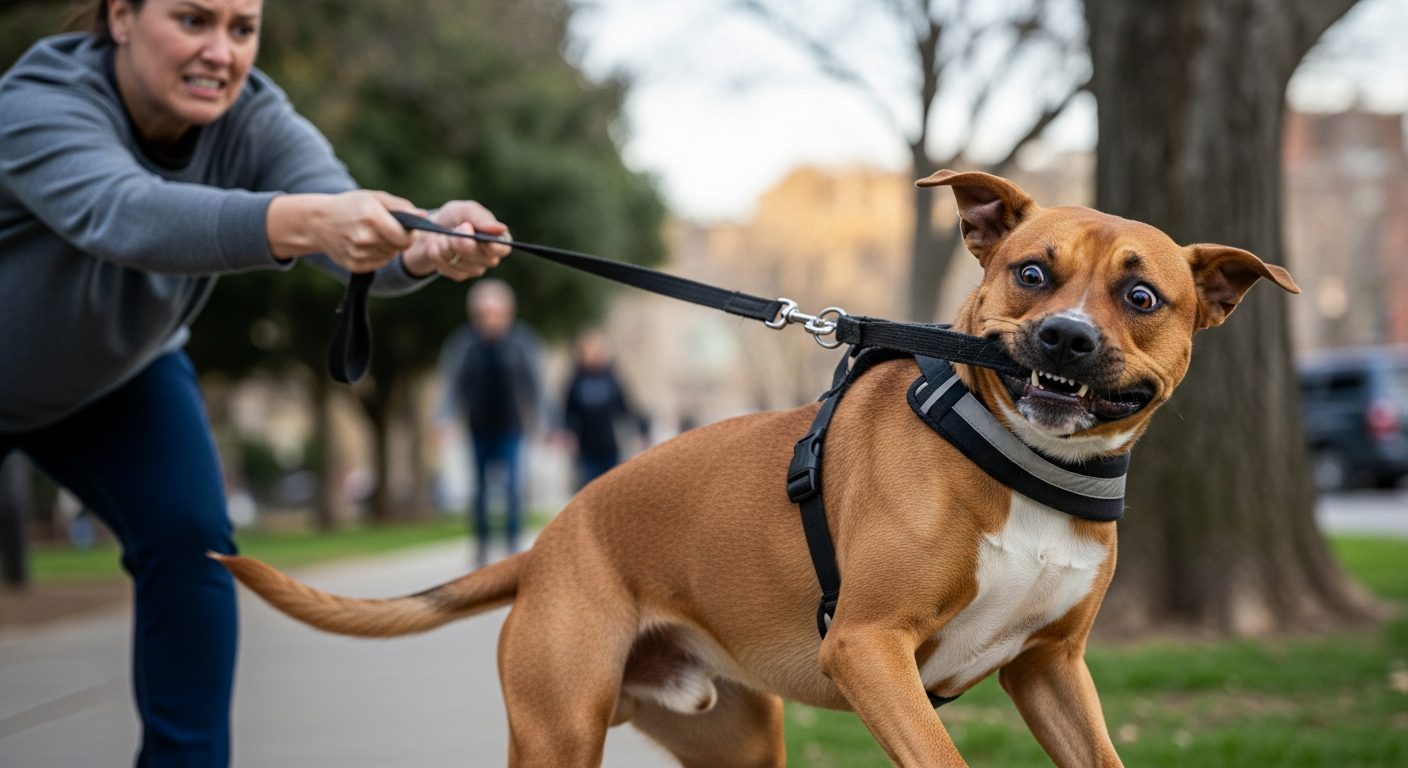
I used to be a member of the "Midnight Walker" club. You know the routine—walk your dog at 11:00 PM or 5:00 AM, scan every driveway for cats, cross the street three times to avoid a Golden Retriever. I lived in constant anxiety, waiting for the moment when my sweet, cuddly, belly-rub-loving boy transformed into a lunging, barking, unrecognizable beast at the end of the leash.
The "Walk of Shame" – My Breaking Point
The breaking point came on a Tuesday morning. I thought the coast was clear. Suddenly, a neighbor turned the corner with her tiny poodle. Max lost his mind. He lunged, I spilled hot coffee all over my hand, and I ended up dragging him away while he barked like a hellhound. The neighbor looked at me with that mix of pity and judgment that just burns.
I went home and cried. I felt like I had failed him.
But here is what I learned after months of research, tears, and training: Max wasn't "bad." He was scared. And I was making it worse by trying to "dominate" him.
If you are currently hiding behind bushes to avoid other dogs, this post is for you. Here is the exact "Zen Walk" method (and the gear) that fixed our walks.
Part 1: The Diagnosis (Is This You?)
Before I bought the right gear, I had to be honest about what was happening.
The "Excited" Puller
- Behavior: Pulls because he wants to say hi. Tail wagging.
- Verdict: Annoying, but not reactive.
The "Reactive" Dog (This was Max)
- The Stare: He would freeze and stare at a dog 50 feet away.
- The "Red Zone": Once he started barking, he wouldn't eat a treat. I could wave a steak in his face, and he wouldn't care.
- The Redirect: In his frustration, he would sometimes nip at the leash or bump my leg.
If your dog enters that "Red Zone" where they stop listening entirely, you can't just "train" them. You have to change their brain chemistry.
Part 2: The Science (My "Aha!" Moment)
I used to yell "NO!" when Max barked. It never worked. Here is why (and learning this changed everything for me).
The "Opposition Reflex"
Have you ever leaned into a heavy door to push it open? That's physics. Dogs have a reflex called the Opposition Reflex. When I pulled tight on Max's collar to hold him back, his body instinctively pulled forward to keep his balance.
My Mistake: By pulling tight on the leash, I was literally signaling him to pull harder. I was fighting physics.
The "Amygdala Hijack"
When Max saw another dog, his brain went into "Fight or Flight." He literally couldn't hear me yelling "No." It's like trying to teach someone math while they are falling out of an airplane. You have to calm the brain before you can teach the dog.
Part 3: The Gear That Saved My Shoulder
I tried everything—choke chains (hated it), gentle leaders (he pawed it off), and expensive "training" collars. Here are the only things that actually worked.
1. The Harness That Stopped the Pulling: 2 Hounds Design Freedom No-Pull
Why I love it: I was skeptical, but the mechanics just work. It has a clip on the front (chest). When Max tries to lunge, the leash pulls his chest to the side, turning him back toward me. It takes away his power without hurting him.
Real talk: The velvet straps are nice because they don't rub his armpits raw like the cheap nylon ones did.
Sizing Tip: Measure the girth (widest part of the chest). If you are between sizes, go up.
2. The "Bio-Hack": ADAPTIL Calm Home Diffuser
Why I love it: This diffuser releases a synthetic copy of the "Dog Appeasing Pheromone" (DAP)—the same scent a mother dog releases to calm her puppies. Plug it in near his bed to create an invisible "safety blanket."
Real Talk: This isn't a magic switch. It won't fix a dog tearing through drywall on its own. But it does lower the general stress level in the house, making training easier.
3. The "Comfort Hug": ThunderShirt for Dogs
Why I love it: The ThunderShirt is one of the most well-known, drug-free anxiety tools. It applies gentle, constant pressure to the torso (similar to swaddling a baby).
The Nuance: Does it work for every dog? No. Some dogs freeze up when wearing it. But for about 80% of dogs, it takes the edge off the panic. It is a low-risk option to try before moving to medication.
Best For: Dogs who pace, shiver, or pant heavily as you prepare to leave.
4. The "Distraction": Lickimat Soother
Why I love it: Unlike a bowl, a Lickimat requires focus. Licking can be self-soothing—the repetitive motion tends to calm most dogs by releasing endorphins.
The Recipe: Freeze peanut butter (make sure it has NO xylitol) or plain Greek yogurt on this mat. Give it to them right as you pick up your keys.
5. The "Gentle Support": Zesty Paws Calming Bites
Why I love it: These chews use Suntheanine® (L-Theanine) and Ashwagandha, ingredients known to support relaxation.
The "Zen" Feature: Think of this as a "chill pill" that doesn't turn your dog into a zombie. It just takes the volume of their anxiety from a 10 down to a 6.
Note: These are supplements, not pharmaceuticals. For severe cases, your vet may prescribe stronger medication. These chews are excellent for mild anxiety or as a complementary support.

Part 4: The "Zen Walk" (Our New Routine)
Do not try to train during the meltdown. Once he's barking, it's game over. The goal is to stay boring.
Step 1: The "U-Turn" (The Nope! Move)
This was the hardest thing for me to learn because I felt silly doing it.
The Move: If I see another dog 50 feet away, and Max's ears perk up (The Stare), I don't wait. I say "Let's Go!" in a super happy voice and we turn 180 degrees and walk away.
Why: Distance is safety. I'm showing him, "I got this. We don't have to deal with that scary thing."
Step 2: The "Look at That" Game
This is how we rewired his brain.
- Max looks at a dog (from far away).
- I click (or say "Yes!") the second he looks.
- He looks back at me for the liver treat.
- The Result: Now, when he sees a dog, he looks at me like, "Hey mom, I saw a dog, where's my liver?"
Step 3: The "Sniffari" (Decompression)
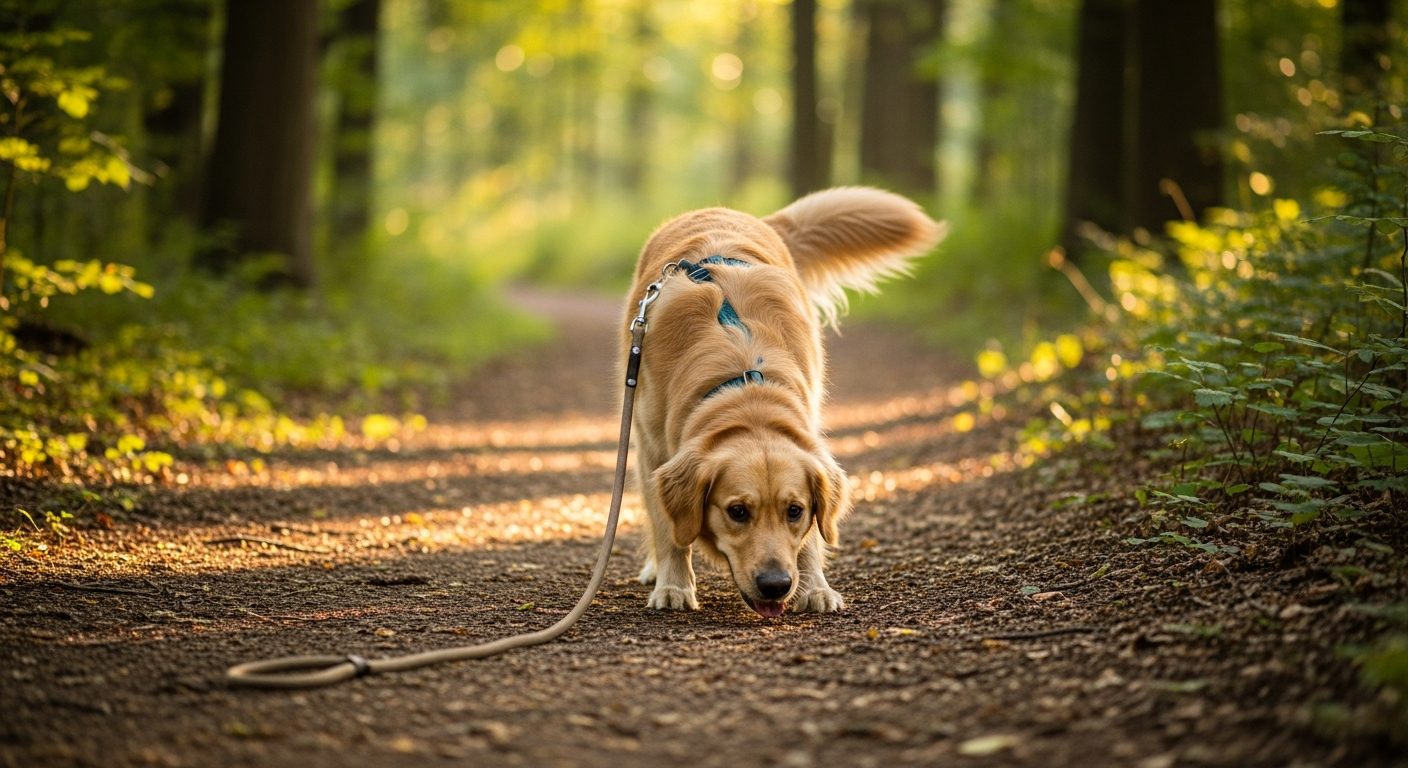
I stopped caring about "distance." Now, we go to empty parking lots or quiet trails and I put him on a long leash. I let him sniff the same bush for 5 minutes if he wants.
Funny side note: It is boring for me. I just stand there. But sniffing lowers a dog's heart rate. A 20-minute "Sniffari" tires Max out more than a 1-hour fast walk.
When to Call a Pro
I want to be responsible here. I handled Max because he was frustrated, not aggressive. If your dog has bitten someone, or if you are physically afraid you can't hold them, please hire a local trainer (look for CPDT-KA letters after their name). It's worth the money.
FAQ: Questions I Had Starting Out
Q: Can I use a prong collar?
A: I tried it once. It made Max worse. When he saw a dog, the collar pinched him. He started thinking "Other Dog = Pain." It backfired. The harness worked way better for us because it didn't add pain to his fear.
Q: How long until he stops barking?
A: It took us about 3 months to get "good." Now, a year later, we can walk past dogs on the other side of the street. He still has bad days, but I don't cry in my car anymore.
Q: My dog hates the harness. What do I do?
A: Max hated it too. I spent a week just putting it on him, feeding him liver, and taking it off. I didn't even walk him in it. I made the harness predict the jackpot.
The Bottom Line
You aren't a bad owner. You just need better tools and a little less pressure. Put on the harness, grab the smelly liver treats, and take a deep breath. You got this.
Related Articles: