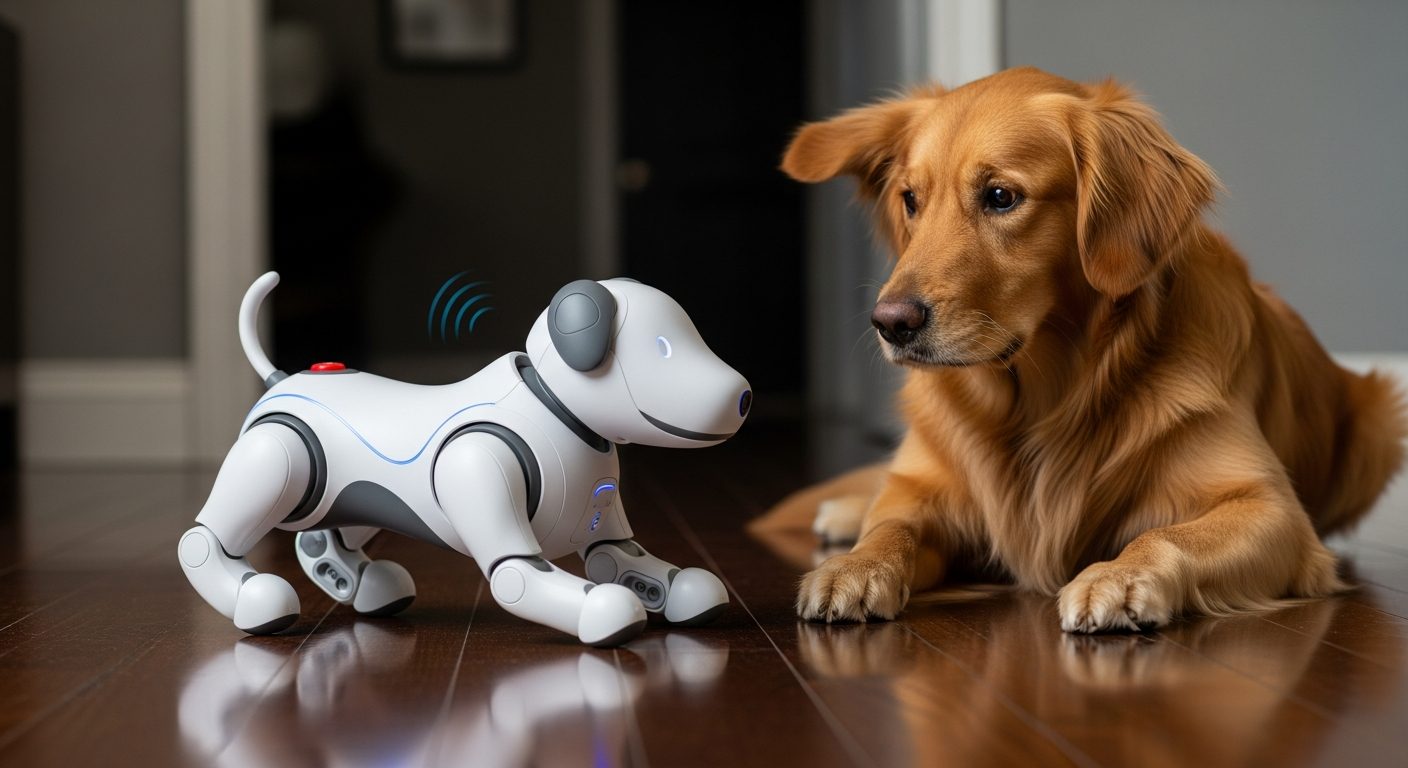
I bought my Border Collie, Luna, the "world's hardest" puzzle toy. It was supposed to provide 45 minutes of engagement. It had sliding compartments, spinning discs, and a locking mechanism that even I struggled with. She solved it in 45 seconds. She looked up at me, tail wagging, and dropped the empty toy at my feet as if to say, "What else you got?"
Traditional puzzle toys have a fundamental flaw: They don't get harder.
Once your dog cracks the code, the toy is dead. It becomes background furniture. You buy another "level 3" puzzle, and they solve that one in 90 seconds. The cycle repeats until your closet is full of expensive plastic that your dog ignores.
But in 2026, a new category of dog enrichment has emerged: AI-Powered Smart Toys. These are not just puzzle feeders. They are adaptive platforms that use machine learning to observe how your dog plays, identify their strengths and weaknesses, and dynamically adjust the challenge in real-time.
They don't just occupy your dog. They evolve with them.
In this guide, we are going to explore the best AI dog toys of 2026, break down the real costs (spoiler: subscriptions are involved), and help you decide if this technology is worth the investment—or if a $15 snuffle mat still does the job better.
In This Guide:
Part 1: The Shift from "Puzzle" to "Platform"
To understand why AI toys are different, you need to understand the fundamental limitation of traditional puzzle toys.
The "One Trick Pony" Problem
A traditional puzzle toy has a fixed solution. It might have 3 "difficulty levels" determined by how you set it up, but the mechanism is always the same. Slide this, lift that, get the treat.
Dogs are pattern-recognition machines. Once they decode the pattern, the puzzle is no longer a puzzle. It is just a slightly inconvenient food dispenser. The mental stimulation drops to zero.
This is why your dog got bored of that $40 Nina Ottosson puzzle after 3 days.
The AI Advantage: Variable Difficulty
AI-powered toys work differently. Instead of a fixed solution, they use sensors (cameras, accelerometers, treat counters) to monitor how your dog interacts with the device. The onboard software then adjusts the challenge based on performance.
- Did your dog solve the puzzle too fast? The next round adds a delay, requires a different action, or increases the number of steps.
- Did your dog give up in frustration? The system dials back the difficulty and offers an "easy win" to rebuild confidence.
- Did your dog ignore the toy entirely? Some devices can trigger attention-grabbing sounds or movements to re-engage them.
This creates a "flow state" for your dog—the sweet spot where the challenge is hard enough to be engaging but easy enough to be achievable. It is the same principle that makes video games addictive for humans.
Tapping Into Prey Drive
The most advanced AI toys go beyond puzzles. They simulate prey behavior. The Varram Pet Fitness Robot, for example, rolls around the floor in unpredictable patterns, mimicking the movements of a small animal. This triggers your dog's innate prey drive—the same instinct that makes them chase squirrels.
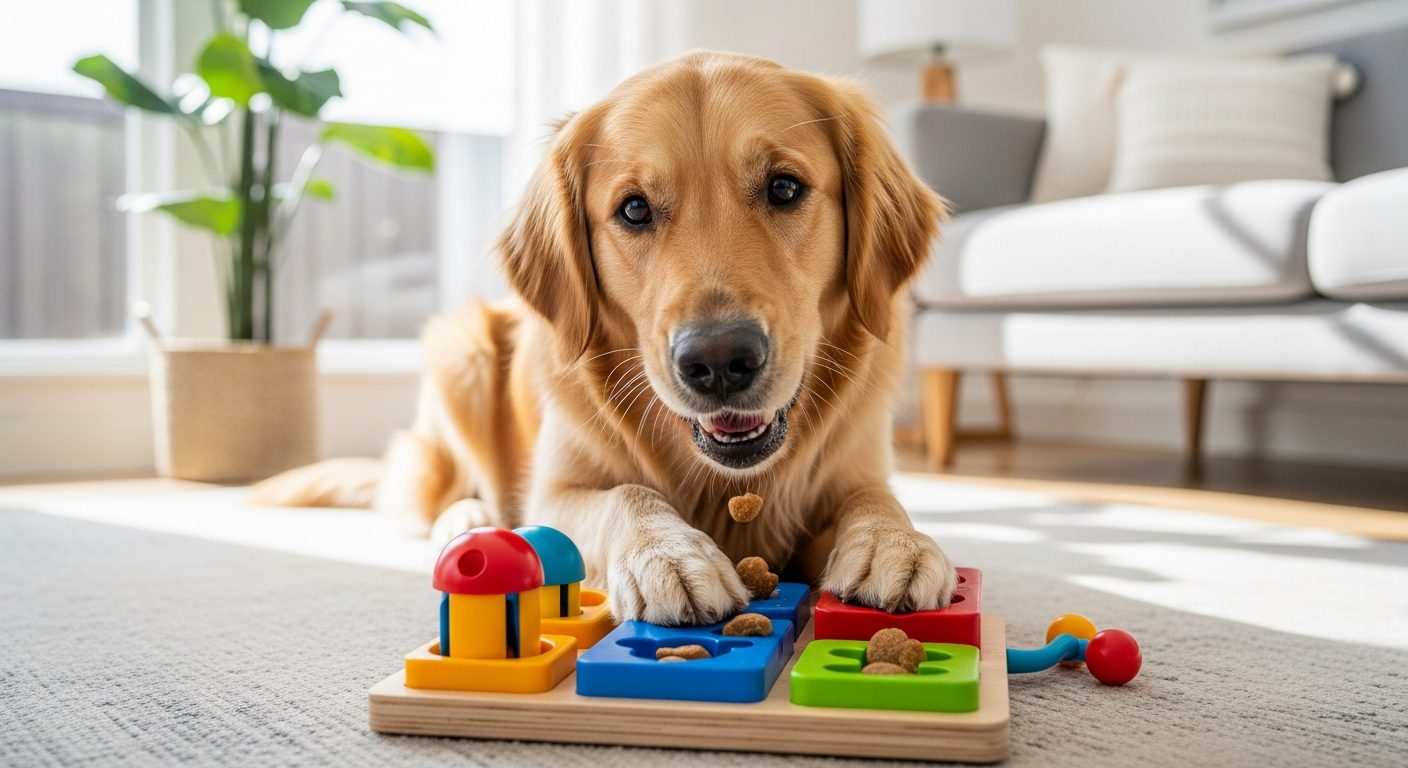
The difference between chasing a ball (predictable trajectory) and chasing a Varram robot (unpredictable AI-driven movements) is the difference between watching a rerun and watching live TV. The uncertainty creates engagement.
Part 2: The Top 3 AI Smart Toys of 2026
After testing dozens of devices and reading through thousands of user reviews, we have narrowed down the field to three standout products. Each serves a different type of dog and owner.
1. Companion Robot: The "Robot Nanny"
Best For: Dogs with separation anxiety; owners who work long hours; multi-pet households.
The Companion is not just a toy—it is a mobile, AI-driven robot that provides full-spectrum enrichment while you are away. Think of it as a Roomba that plays with your dog instead of vacuuming your floor.
Key Features:
- Autonomous Navigation: It roams your house independently, avoiding obstacles and seeking out your dog.
- Treat Dispensing: Rewards your dog for engagement, with adjustable portion control.
- Two-Way Audio/Video: Allows you to speak to your dog and watch live via your phone.
- AI Play Modes: Includes "Chase Me" mode (it runs away), "Treat Hunt" mode (it hides and dispenses treats when found), and "Calm Mode" (gentle movements for anxious dogs).
- Behavioral Learning: The AI learns your dog's preferences over time and adjusts play patterns accordingly.
The Catch: This is the most expensive option on the list. It requires a subscription for full AI features. It is also best suited for larger homes with smooth floors; it struggles on thick carpet.
Real User Feedback: "My Aussie used to destroy the house when I left for work. Since getting the Companion, he spends his day playing and napping. The destruction has stopped completely."
2. Varram Pet Fitness Robot: The "Hunter"
Best For: High-energy dogs; dogs with strong prey drive; owners who want physical AND mental exercise.
The Varram is a treat-dispensing robot that rolls around your floor in unpredictable patterns, designed to simulate the movement of fleeing prey. It is smaller and simpler than the Companion, but incredibly effective at triggering the chase instinct.
Key Features:
- AI Movement Patterns: Uses sensors to detect your dog's position and adjust its escape route. It doesn't just roll in a straight line; it dodges and weaves.
- Treat Dispensing: Rewards your dog periodically for engagement, keeping the "hunt" rewarding.
- Scheduled Play: Can be set to activate at specific times (e.g., when you leave for work).
- App Control: Allows manual override to drive the robot yourself.
- Fitness Tracking: The app tracks how far your dog has "chased" the robot, turning exercise into a game.
The Catch: It is not designed for very large or aggressive dogs who might destroy it. It also requires smooth floors to roll effectively. The battery life is about 1.5-2 hours of active play.
Real User Feedback: "My Beagle goes absolutely insane for this thing. He will chase it until he is panting and exhausted. Best money I ever spent on a dog toy."
3. PupPod Rocker: The "Gamer"
Best For: Smart dogs who need cognitive challenge; dogs in recovery (limited mobility); owners who want measurable mental exercise.
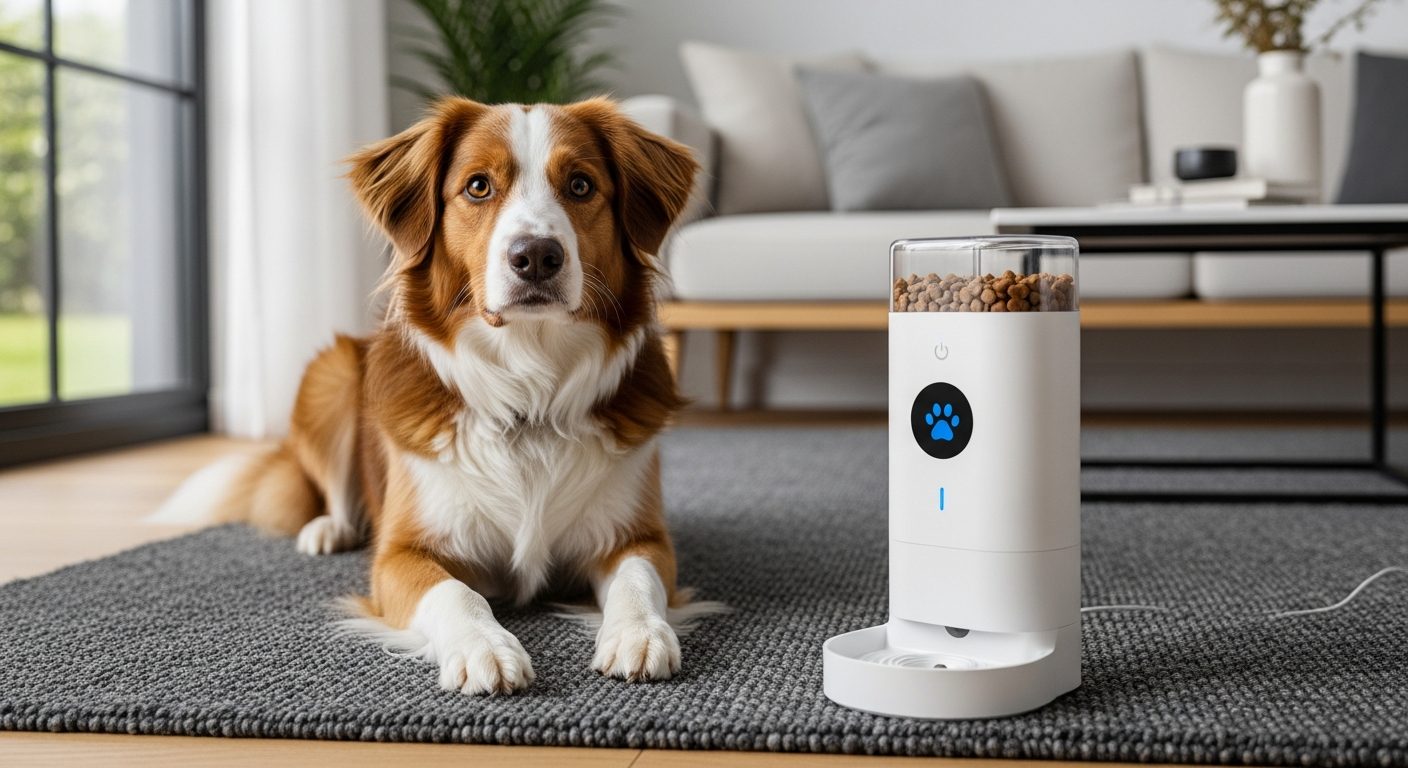
The PupPod Rocker is different from the other two. It is not a mobile robot; it is a stationary cognitive training system. Think of it as a video game console for your dog.
The system consists of two parts: the PupPod (a wobble toy with lights and sounds) and the Feeder (a treat-dispensing base). The dog must interact with the PupPod in specific ways (push it when a certain light flashes, ignore it when another light flashes) to earn a treat from the Feeder.
Key Features:
- Adaptive Difficulty: The AI tracks your dog's success rate. If they get too good, it adds new rules (e.g., "only push when the GREEN light is on AND the buzzer sounds"). If they struggle, it simplifies the task.
- Cognitive Metrics: The app provides detailed data on your dog's learning curve, session length, and accuracy.
- Remote Play: You can watch live and even trigger treat rewards manually via the app.
- Multiple Game Modes: Includes memory games, reaction time games, and even "cool down" modes for senior dogs.
The Catch: This is a brainwork tool, not a physical exercise tool. It will not tire out a hyperactive puppy through running. It also has the steepest learning curve for both dog and owner. Some dogs take days to understand the rules.
Real User Feedback: "My 12-year-old Lab had CCD (dog dementia). The PupPod gave him something to focus on every day. His cognitive decline has visibly slowed since we started using it."
Part 3: The Real Cost Breakdown
Let's talk about the elephant in the room: These toys are expensive. And many of them come with ongoing subscription fees to unlock the full AI features. Here is the honest breakdown.
| Product | Upfront Cost | Monthly Subscription | 1st Year Total Cost |
|---|---|---|---|
| Companion Robot | $599 | $29/month (optional) | $599 - $947 |
| Varram Pet Fitness | $149 | None | $149 |
| PupPod Rocker System | $249 | $9.99/month (optional) | $249 - $369 |
What Do the Subscriptions Actually Get You?
- Companion: The subscription unlocks advanced AI play modes, behavioral analytics, cloud video storage, and future firmware updates. Basic functionality works without it.
- Varram: No subscription required. All features are included with the hardware purchase.
- PupPod: The subscription unlocks advanced game modes, detailed cognitive analytics, and multi-dog profiles. The basic "wobble and treat" function works without it.
Our Take: If you are spending $249+ on a device, we recommend budgeting for at least 3-6 months of the subscription to truly evaluate whether the AI features make a difference for your dog. After that, you can decide if it is worth continuing.
Part 4: Budget Alternatives That Still Work
Not everyone can drop $600 on a robot. And honestly? Not every dog needs one. Here are proven, low-cost enrichment strategies that provide 80% of the benefit at 5% of the cost.
1. DIY Enrichment: The Cardboard Box Method
This costs $0 and works beautifully for most dogs.
How to Do It: Save your Amazon boxes. Stuff them with crumpled newspaper and hide treats inside. Tape them shut loosely. Let your dog destroy them to find the treasure.
Why It Works: The destruction is the reward. Dogs are natural scavengers. Tearing apart a box to find food triggers the same foraging instincts that the fancy AI toys are trying to replicate.
Level Up: Put a small box inside a medium box inside a large box. This creates a multi-layer puzzle that can occupy a dog for 20-30 minutes.
2. Snuffle Mats: The Nose Workout
Snuffle mats are fabric mats with dense felt strips that hide food. Your dog has to use their nose to forage through the "grass" to find the kibble.
Why It Works: Sniffing is incredibly calming for dogs. It engages the parasympathetic nervous system (the "rest and digest" response). A 10-minute snuffle session can lower heart rate and cortisol levels.
Our Pick: The PAW5 Wooly Snuffle Mat is durable, machine washable, and the "grass" is dense enough to actually challenge your dog.
3. Scatter Feeding: Ditch the Bowl Entirely
This is the simplest enrichment strategy that most owners overlook.
How to Do It: Instead of putting your dog's food in a bowl, scatter it across the yard (or a large room). They have to hunt for every piece.
Why It Works: Dogs in the wild spend 80% of their waking hours searching for food. We have condensed this into a 30-second bowl inhale. Scatter feeding restores the natural "work for food" instinct.
Pro Tip: Scatter feed in a kiddie pool filled with plastic balls for an extra challenge (sometimes called a "ball pit feeder").
Part 5: Risks to Watch
AI dog toys are not without their downsides. Before you invest, consider these potential issues.
1. The Frustration Gap
AI difficulty adjustment is not perfect. Sometimes the system misjudges and makes the game too hard, causing your dog to give up in frustration. Repeated failure can lead to learned helplessness—where your dog stops trying altogether.
The Fix: Always supervise the first few sessions. If your dog is whining, barking, or walking away repeatedly, intervene. Reset the difficulty manually or offer an "easy win" by dispensing treats directly.
2. Privacy Concerns
Devices like the Companion Robot have cameras and microphones that stream video to the cloud. This data is stored on company servers. While companies claim it is encrypted and secure, you are essentially installing a surveillance device in your home.
The Fix: Read the privacy policy carefully. Opt out of data sharing if possible. Some users cover the camera when not in use or place the device in a single room.
3. Over-Feeding and Weight Gain
All of these toys dispense treats. If your dog is playing for hours a day, those calories add up. We have seen dogs gain significant weight after getting an automated treat dispenser because owners forgot to adjust meal portions.
The Fix: Use your dog's regular kibble as the "treat" in these devices instead of high-calorie snacks. Subtract any treats dispensed from their daily food allowance.
4. Device Dependency
Some dogs become obsessed with their AI toy to the point of ignoring human interaction. This can actually increase anxiety when the device is off or broken.
The Fix: Set time limits. Use the device as a supplement to human interaction, not a replacement. Schedule dedicated play sessions with YOU every day.
5. Durability for Power Chewers
None of these devices are designed to be chewed. If your dog is a power chewer who destroys everything, they may damage the device (and potentially ingest plastic or electronics).
The Fix: Always supervise sessions until you know how your dog interacts with the device. If they show any signs of trying to chew it, switch to more durable enrichment options.
Conclusion: Is AI Enrichment Worth It?
Let's be honest: AI dog toys are a luxury, not a necessity.
If you have a high-energy working breed who is destroying your house out of boredom, a Companion Robot or Varram could be a game-changer. If you have a senior dog with cognitive decline, the PupPod's adaptive brain games might genuinely slow the mental fog.
But if your dog is reasonably content with daily walks, some sniff time, and a frozen Kong, you probably don't need to spend $600 on a robot.
The best enrichment is free: A long decompression walk where your dog gets to sniff everything. A training session where they learn something new. Quality time with you.
Technology can supplement these things. It cannot replace them.
That said, if you are someone who works long hours and worries about your dog being bored and anxious all day, these AI toys offer something that traditional puzzles cannot: Engagement that grows with your dog.
Luna—my 45-second puzzle destroyer—has now been playing with a PupPod for three months. She has progressed through 12 difficulty levels. The game has evolved from "push the wobbler when any light flashes" to "push only when the green light flashes AND the high-pitched beep sounds, but NOT when the red light is on." She is still learning. She is still engaged.
That, to me, is worth the investment.
FAQ: Common Questions About AI Dog Toys
Q: Can AI toys replace human interaction?
A: No. AI toys are a supplement, not a replacement. Dogs need daily social interaction with their humans. Use these devices to enrich alone time, but prioritize quality time together when you are home.
Q: Are AI toys safe for puppies?
A: It depends on the puppy. Most AI toys are designed for adult dogs. Puppies may be too rough and damage the device, or they may become frustrated by the adaptive difficulty before they understand the rules. We recommend waiting until your dog is at least 12 months old.
Q: What if my dog ignores the AI toy?
A: Most devices have a "warm-up" period. Start with the toy in manual mode (you control the treat dispensing) so your dog learns that the device equals rewards. Gradually transition to autonomous mode once they are interested.
Q: Do I need Wi-Fi for these toys?
A: For full functionality (app control, behavioral analytics, cloud features), yes. However, most devices offer a basic offline mode that provides core functionality without internet access.
Q: How long do these toys last?
A: With proper care, most AI toys last 2-5 years. The main points of failure are battery degradation (for mobile devices) and motor wear. Look for devices with replaceable parts or strong warranty coverage.
Smart Pet Feeder with Camera
Monitor and feed your pet remotely with this smart feeder featuring a built-in HD camera. Schedule meals, dispense treats, and check in from anywhere.
Check Price on Amazon →Summary: The Future of Dog Enrichment
We are living through a revolution in pet care technology. What was science fiction five years ago—a robot that learns your dog's behavior and adapts in real-time—is now available on Amazon.
But technology is only as good as the intention behind it. The goal is not to outsource your dog's happiness to a machine. The goal is to provide richer, more stimulating experiences during the hours when you cannot be there.
Whether you choose a $600 robot or a $0 cardboard box, the principle is the same: A tired brain is a happy brain.
Now go make your dog think.