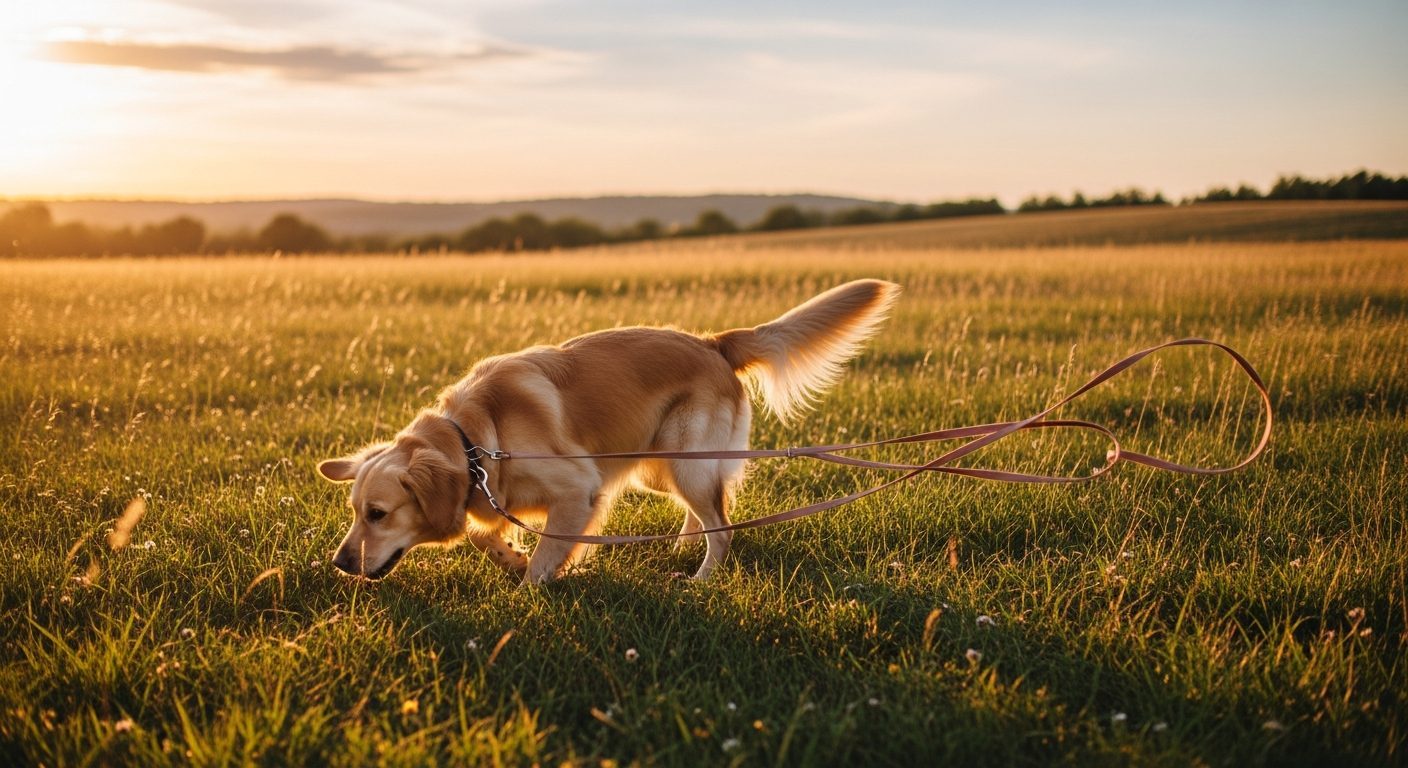
Luna was labeled "aggressive" by three different trainers. The 4-year-old Australian Shepherd lunged at bicycles, barked at other dogs, and would spin in frantic circles when her owner, Maria, reached for the leash. Maria was at her breaking point.
"I was told she needed more exercise," Maria told us. "So I started running with her every morning. She got worse. More reactive. More frantic. She couldn't settle down at night. I thought I had a broken dog."
Then Maria learned about Decompression Walks.
Within three weeks of switching from "power walks" to quiet, sniff-focused outings in nature, Luna's transformation was undeniable. The lunging decreased. The spinning stopped. For the first time in months, she fell asleep peacefully after her walks instead of pacing the house.
Luna wasn't aggressive. She wasn't broken. She was drowning in cortisol.
This article is the science behind the magic. If you have a reactive, hyperactive, or anxious dog who seems to get worse despite your best efforts, this might be the most important concept you ever learn.
In This Guide:
Part 1: The Science of the Cortisol Curse
To understand why Luna was struggling, we need to understand two hormones: Adrenaline and Cortisol.
Adrenaline: The Lightning Bolt
When your dog sees a squirrel, adrenaline floods their system instantly. Heart rate spikes. Muscles tense. Eyes dilate. This is the "fight or flight" response, and it's designed to be short. The squirrel runs away, the adrenaline fades, and the dog returns to baseline within minutes.
Adrenaline is like a lightning strike—intense but brief.
Cortisol: The Slow Burn
Cortisol is different. It's released by the adrenal glands in response to prolonged or repeated stress. While adrenaline is the initial alarm, cortisol is the "state of emergency" that lingers long after.
Here's the critical fact most dog owners don't know: Cortisol takes 72 hours to fully leave a dog's system.
That's three days. If your dog has a stressful encounter on Monday morning (a barking dog on the walk, a loud truck, a scary stranger), their cortisol won't fully clear until Thursday morning.
The 72-Hour Sensitization Effect
While cortisol is still elevated, the dog's nervous system is on a hair trigger. Things that wouldn't normally bother them suddenly become intolerable. Their threshold for reactivity drops dramatically.
This means that if your dog has another stressful experience on Tuesday (before the Monday cortisol clears), the two stress events stack. The cortisol compounds. And now they won't return to baseline until Friday—or later.
Understanding Trigger Stacking
This phenomenon is called Trigger Stacking, and it explains why reactive dogs often seem unpredictable. It's not that they randomly "lost it." It's that they were already swimming in a sea of unprocessed stress hormones when one final trigger pushed them over the edge.
Imagine you've had a terrible day at work, got stuck in traffic, and burned dinner. Then your kid spills milk on the floor. Normally, you'd calmly grab a towel. But today? You might snap. That's trigger stacking.
Your reactive dog isn't being "bad." They are biologically overwhelmed.
The Urban Dog Disaster
Now consider the life of a typical urban dog:
- Morning Walk: Sees two dogs, hears three car horns, a skateboard zooms past.
- Afternoon: Delivery person rings doorbell, dog barks for 10 minutes.
- Evening Walk: Another reactive dog lunges from across the street.
This dog never gets below their stress threshold. Their cortisol is constantly elevated, day after day, week after week. Their baseline shifts higher and higher. What we see as "aggression" or "hyperactivity" is actually a dog in chronic biological distress.
This is the Cortisol Curse. And the only way to break it is to stop the flood.
Part 2: The Olfactory Hack (Why Sniffing is Medicine)

Here's where the magic happens. Researchers have discovered something remarkable about a dog's nose: Sniffing activates the parasympathetic nervous system.
The parasympathetic system is the "rest and digest" state—the opposite of fight or flight. When a dog is deeply engaged in sniffing, their pulse lowers, their muscles relax, and their brain shifts into a calm, focused state.
The Duranton & Horowitz Study
A landmark 2019 study by researchers Charlotte Duranton and Alexandra Horowitz measured the effects of olfactory enrichment on dogs. They found that dogs who were allowed to sniff freely during walks showed significantly lower stress behaviors than dogs on structured, heel-focused walks.
The sniffing dogs displayed:
- Lower heart rates
- Reduced cortisol levels in saliva tests
- More "optimistic" behavior in subsequent cognitive tests
- Better sleep quality that night
In other words, sniffing doesn't just tire them out—it chemically resets their stress hormones.
Why Sniffing Works
A dog's brain dedicates 40% of its processing power to olfactory information (compared to about 5% in humans). When they sniff, they are reading a complex "newspaper" of information about who's been there, what they ate, and how they were feeling.
This deep mental engagement is inherently calming. It's like the difference between mindlessly scrolling social media (stimulating but draining) versus reading an engrossing novel (engaging but restorative).
Dr. E'Lise Christensen, a veterinary behaviorist, puts it this way: "Olfactory enrichment is one of the most underutilized tools in behavioral medicine. A 20-minute sniff walk can be more restorative than a 2-hour fetch session."
The "Sniffari" Concept
Some trainers call these sniff-focused outings "Sniffaris"—a playful combination of sniff and safari. The dog is the explorer, the human is just the guide holding the leash. You go where the nose leads.
This is the foundation of the Decompression Walk.
Part 3: Anatomy of a Decompression Walk
A Decompression Walk isn't just a slow walk. It's a completely different philosophy of dog walking. Here's how it differs from a traditional walk:
Traditional Walk vs. Decompression Walk
| Aspect | Traditional Walk | Decompression Walk |
|---|---|---|
| Goal | Exercise, bathroom, "burn off energy" | Mental reset, stress relief, cortisol reduction |
| Location | Neighborhood sidewalks, busy streets | Quiet trails, fields, low-traffic nature areas |
| Leash | 4-6 foot standard leash | 15-30 foot long line |
| Pace | Brisk, human-determined | Dog-determined, often very slow |
| Direction | Human chooses the route | Dog follows their nose |
| Sniffing | "Come on, let's go!" (sniffing discouraged) | Unlimited sniffing is the entire point |
| Duration | 30-60 minutes | 20-45 minutes (quality over quantity) |
| Triggers | High (traffic, people, dogs) | Minimal (isolated environment) |
The Essential Gear Setup
To do Decompression Walks correctly, you need to ditch the standard equipment.
1. The Long Line (15-30 feet)
A standard 6-foot leash keeps the dog in your "bubble." This creates tension—both physical (on their neck) and psychological (they can't explore freely). A long line gives them the illusion of freedom while you maintain control.
Key features to look for:
- Biothane or waterproof material (gets muddy and wet)
- Lightweight so it doesn't drag them down
- No handle loop at the end (can snag on branches)
2. The Y-Front Harness
Never walk a reactive dog on a collar. If they lunge, the pressure on their throat triggers more panic (and can damage the trachea and thyroid gland). A Y-front harness distributes pressure across the chest, allowing full shoulder movement without restriction.
The Blue-9 Balance Harness is our top recommendation because it allows natural movement while preventing escape. The front clip can redirect lunging without choking.
3. High-Value Treats
Bring treats, but not for training commands. Use them for "engagement markers"—when your dog voluntarily checks in with you or calmly moves away from a potential trigger, you can quietly reward that choice.
Choosing the Right Location
This is critical. The location makes or breaks a Decompression Walk.
Ideal locations:
- Quiet hiking trails (weekday mornings are best)
- Open fields without other dogs
- Sniff-rich environments (tall grass, wooded areas)
- Fenced private land (if you're lucky)
Locations to avoid:
- Dog parks (high arousal, no control over triggers)
- Busy sidewalks and urban streets
- Popular trail times (weekends at noon)
- Anywhere you're likely to encounter off-leash dogs
For many urban dog owners, finding a quiet space requires driving 15-20 minutes. Think of it as a therapeutic investment. That drive pays dividends in reduced reactivity all week.
Part 4: The 7-Day Cortisol Reset Protocol
If your dog is in chronic cortisol overload, you can't just add one Decompression Walk and expect miracles. You need a "reset period" to let their system finally drain.
Here is the protocol used by many force-free trainers:
Days 1-3: Complete Trigger Avoidance
Goal: Give their cortisol 72 hours to fully clear.
- No neighborhood walks. For three days, skip the standard walk entirely. Use backyard potty breaks or a quiet side street at odd hours (5 AM, 10 PM).
- No exciting activities. No fetch, no dog park, no visitors. Boring is the goal.
- Increase indoor enrichment. Snuffle mats, lick mats, frozen Kongs. Keep their brain engaged without adrenaline spikes.
- Manage the environment. Close blinds if they bark at passersby. Use white noise to muffle outside sounds.
This will feel counterintuitive. "But my dog needs exercise!" you'll think. Trust the process. Three days of calm will do more than three weeks of trigger-filled walks.
Days 4-7: Introduction of Decompression Walks
Goal: Replace stressful walks with restorative ones.
- Day 4: First Decompression Walk. Drive to a quiet location. Walk for 20 minutes on the long line. Let them sniff everything. Move slowly. If they want to stand and sniff one bush for 4 minutes, let them.
- Day 5: Second walk. Extend to 30 minutes if they seem relaxed.
- Day 6-7: Continue daily. You should start seeing changes—softer eyes, looser body, voluntary check-ins.
Ongoing Maintenance
After the reset week, aim for at least 3-4 Decompression Walks per week. You can cautiously reintroduce neighborhood walks for bathroom breaks, but always ask yourself: "Is this walk adding to my dog's cortisol load or reducing it?"
If the answer is "adding," skip it and do a Sniffari instead.
Signs the Protocol is Working
Within 1-2 weeks, owners typically report:
- Faster settling after coming home
- Longer and deeper sleep
- Increased tolerance for minor triggers
- More voluntary engagement with the owner
- Reduction in displacement behaviors (lip licking, yawning, scratching)
Part 5: Common Myths Debunked
Myth #1: "But My Dog Will Pull!"
This is the most common objection. And yes, initially, some dogs will pull toward interesting smells. That's okay.
The long line isn't about perfect leash manners. It's about giving freedom without danger. If they pull toward a scent, simply follow them (within reason). You're not training heel; you're allowing exploration.
Over time, as their cortisol drops and they realize sniffing isn't being cut short, the frantic pulling often decreases naturally. They no longer feel rushed.
Myth #2: "My Dog Needs to Be Tired Out"
This is the most damaging myth in dog culture. The idea that a "good dog is a tired dog" has created a generation of adrenaline-addicted, cortisol-flooded dogs who can never truly relax.
High-intensity exercise (running, fetch, agility) releases adrenaline. It feels good in the moment but doesn't teach the dog how to be calm. In fact, it often makes reactive dogs worse because their arousal levels never come down.
The goal isn't a tired dog. The goal is a relaxed dog.
Myth #3: "I Don't Have Time for This"
A Decompression Walk doesn't have to be long. A focused 20-minute Sniffari is worth more than an hour of power-walking. Quality beats quantity every time.
And consider the time you're currently spending: managing reactivity episodes, cleaning up stress-related destruction, vet visits for anxiety-related issues. The upfront time investment in Decompression Walks pays back quickly.
Myth #4: "My Dog Isn't Reactive—They Just Have High Energy"
Many dogs labeled as "high energy" are actually running on cortisol and adrenaline. True high energy looks like a happy dog who can also settle. Cortisol overload looks like a dog who can never stop moving, even when exhausted.
Try the 7-day protocol and see what happens. You might discover your "high energy" dog is actually a calm dog who has never been given the chance to decompress.
Myth #5: "Sniffing is Rude / Unsanitary / A Behavior Problem"
Sniffing is not rude. It's the primary way dogs gather information about their world. Denying sniffing is like blindfolding a human and expecting them to navigate confidently.
Yes, there are times when a quick walk means limited sniffing. But if every walk is a "keep moving" march, you're depriving your dog of a fundamental need.
Conclusion: A New Way of Walking
Remember Luna, the "aggressive" Australian Shepherd from the beginning of this article?
After six weeks of dedicated Decompression Walks, Maria sent us an update: "Luna is a different dog. Not because I trained the reactivity out of her—but because I finally stopped flooding her with stress. She needed less, not more. And now we have walks I actually enjoy."
The Decompression Walk isn't a training technique. It's a lifestyle shift. It requires us to slow down, to let go of our schedules and expectations, and to see the world through our dog's nose.
It asks a simple question: Is this walk for me, or for my dog?
When the answer is "for my dog," everything changes.
So tomorrow morning, grab that long line. Drive to that quiet trail. And let your dog lead. Let them sniff that rock for three minutes. Let them stop and process. Let their cortisol finally, finally drain away.
That's not a walk. That's a reset.