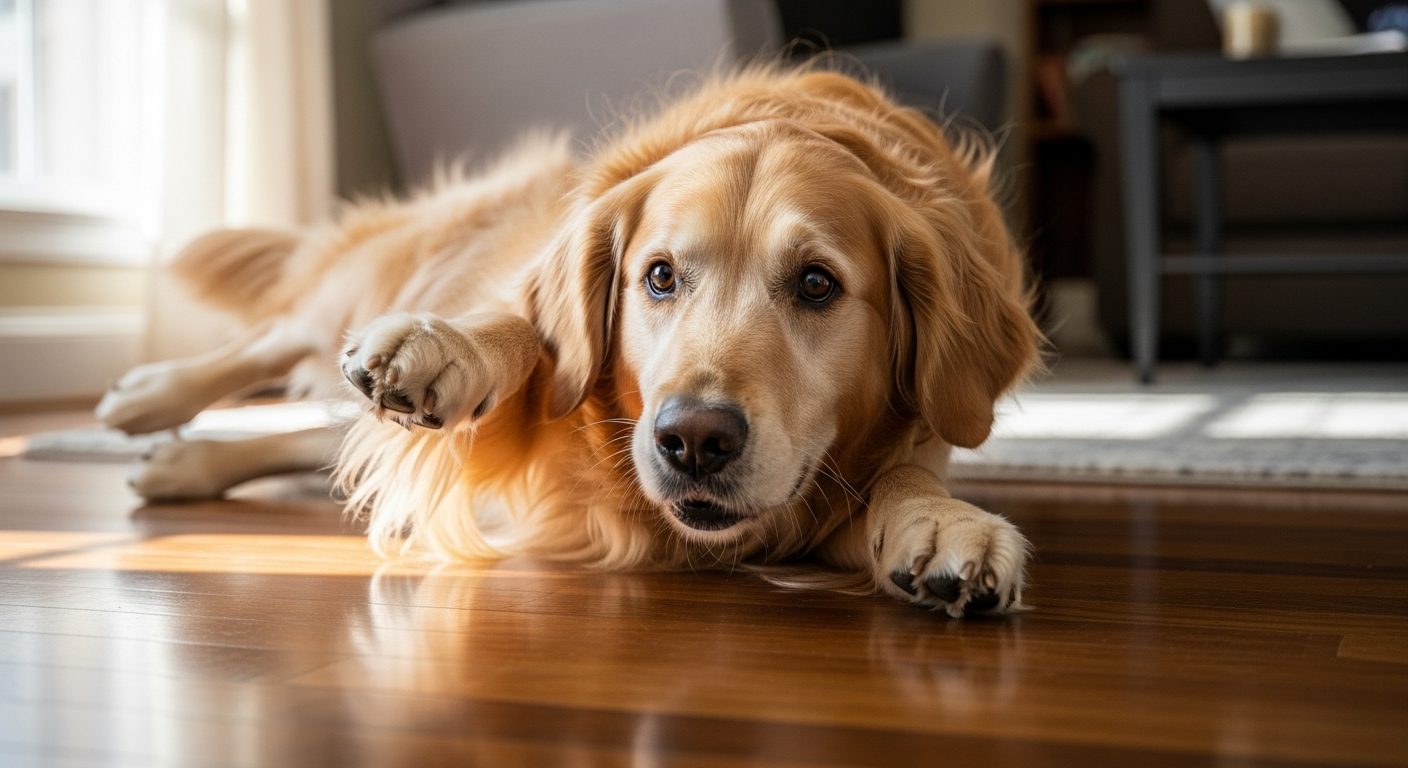
It is a sound every senior dog owner eventually learns to dread. First, there is the scuffle-scuffle of paws trying to find purchase. Then, the frantic scratching of nails against hardwood as panic sets in. And finally—the heartbreaking thud of hips hitting the floor. Your dog has slipped again.
Or perhaps it is the "trapped bark." You walk into the living room to find your dog standing with their nose pressed firmly into the corner behind the sofa, barking rhythmically, unable to figure out how to back up. They look at you with wide, confused eyes, waiting for rescue from a situation that seems impossible to them.
In This Guide:
Introduction: What is Barkitecture?
When a dog develops Canine Cognitive Dysfunction (CCD), or even just general geriatric frailty, their spatial awareness vanishes. The home they have lived in for 12 years—the place that used to be their kingdom—suddenly becomes a terrifying obstacle course of slippery "lava" floors, invisible cliffs, and confusing dead ends.
This isn't just about safety; it is about dignity.
We call this "Barkitecture"—the art of modifying your home architecture to meet your dog where they are today. It is about shifting your mindset from "interior design" to "accessible living."
Yes, your house might look a bit like a padded gym for a while. Yes, you might have mismatched yoga mats in your hallway. But the confidence it gives your dog to walk across the room without fear? That is worth every aesthetic sacrifice.
Part 1: The "Lava" Floor Problem (Why Traction is Everything)
To a healthy dog, a hardwood or tile floor is just a surface. To a senior dog with weak hips, arthritis, and slow reflexes, it feels like walking on a sheet of ice.
The physical danger is obvious (torn ACLs, bruised hips), but the psychological damage is worse. If a dog slips significantly just once, they often develop a profound fear of walking. We call this "The Island Effect." The dog will walk onto a rug (The Island) and refuse to leave it. They will hold their bladder for hours rather than risk stepping onto the "lava" (the wood floor) to get to the back door.
The Fix: The "Yoga Mat Highway"
Many owners try to use socks or "booties" to fix this. The problem: Most dogs hate wearing them. They spin around on the paw, cutting off circulation or actually making the dog slip more if the grip side rotates upward.
The better solution is to change the floor, not the dog.
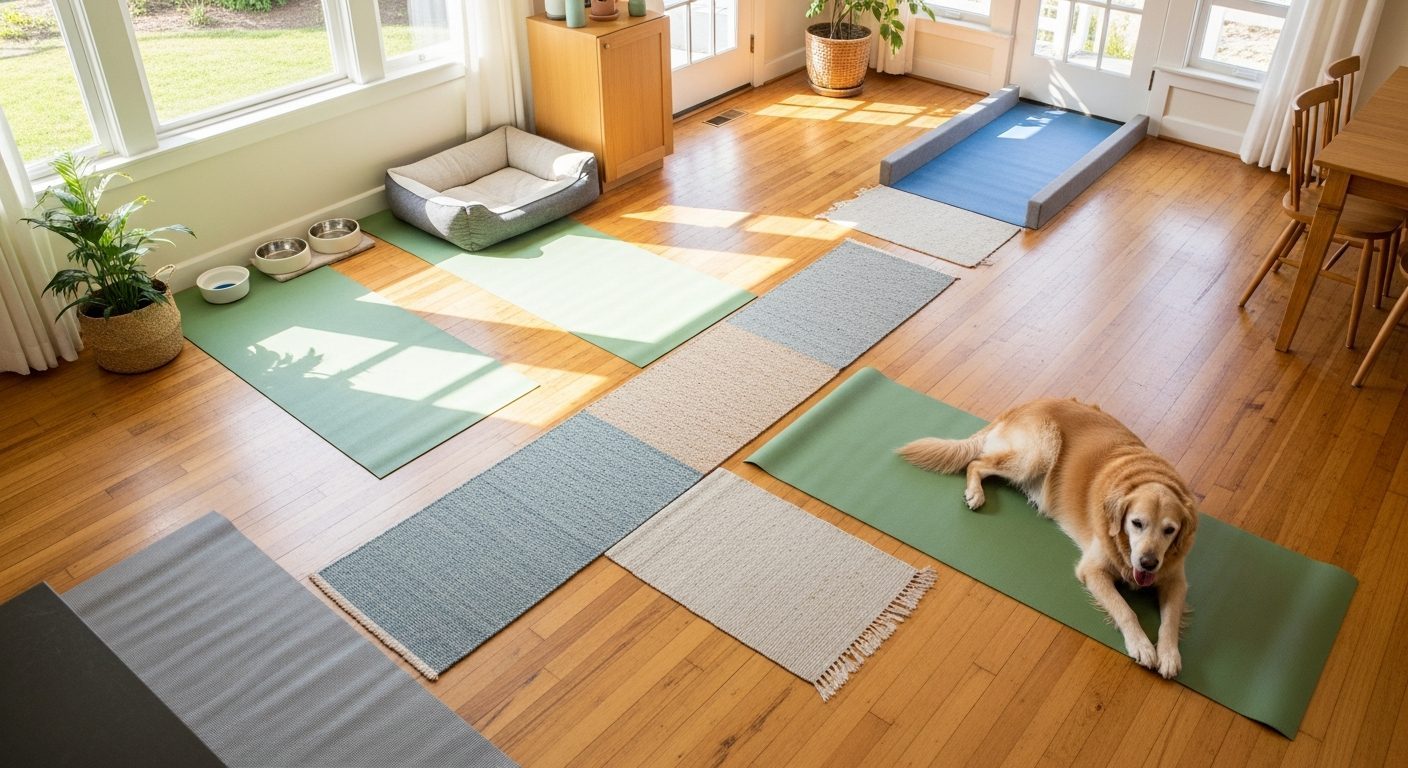
You don't need to re-carpet your whole house. You just need to create "Safe Zones." The solution that actually worked for us was cheap, ugly, and incredibly effective: Yoga Mats. We created a literal path—a "highway"—from his bed, to the water bowl, to the back door.
The Budget Pick: Gaiam Essentials Thick Yoga Mat
- Why: Don't buy expensive Lululemon mats for this. Buy these in bulk. You can use scissors to cut them to fit around corners or door frames.
- Pro Tip: They are easy to wipe down when accidents happen, and the extra thickness cushions their joints.
The Aesthetic Pick: Ruggable Washable Runners
- Why: If you cannot stand the look of yoga mats in your hallway, Ruggable runners are the best high-end alternative.
- The Benefit: They feature a distinct non-slip pad system that actually stays put (unlike cheap throw rugs that slide and become hazards themselves), and the top layer can be peeled off and thrown in the washing machine—essential for the inevitable incontinence issues.
Part 2: The "Corner Trap" (Why They Get Stuck)
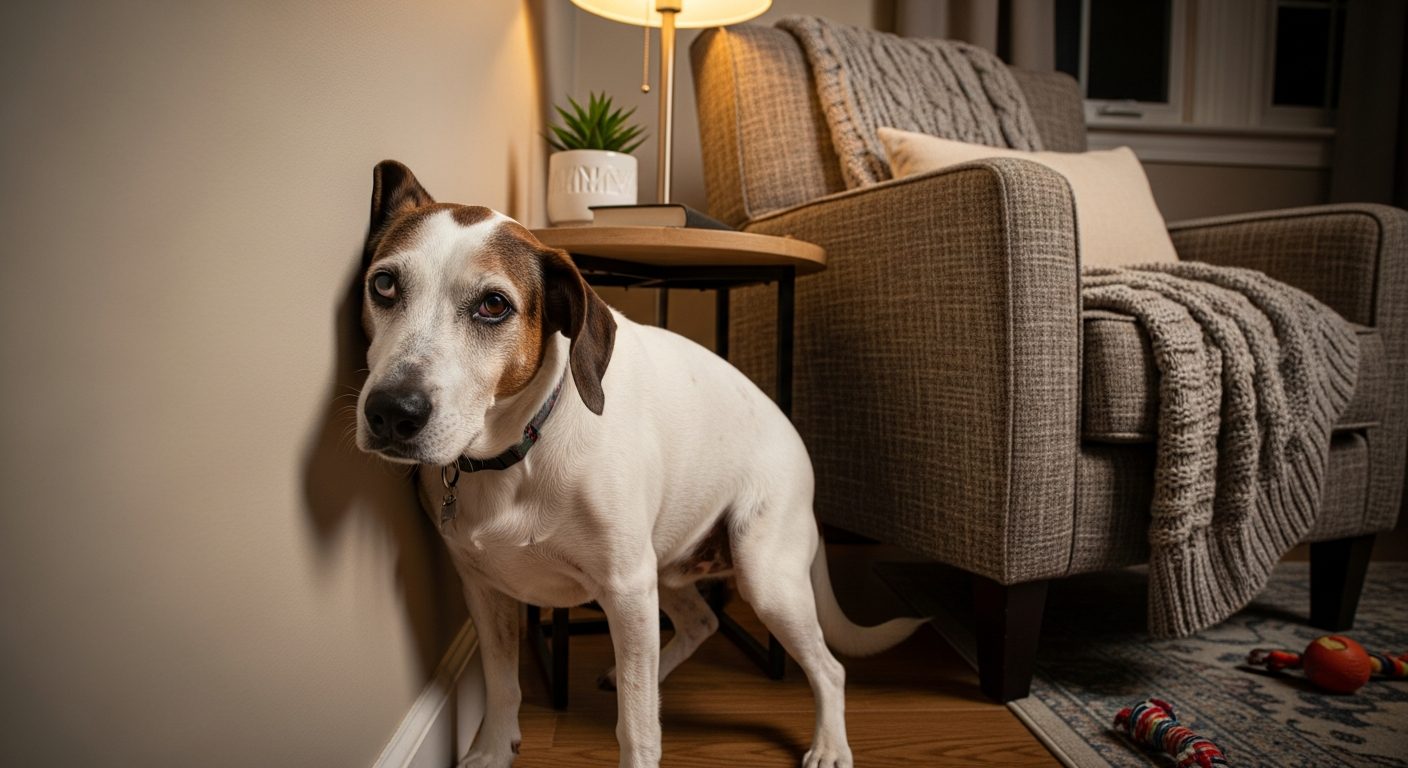
One of the strangest and most distressing symptoms of CCD is the inability to reverse.
Neurologically, the command "walk backwards" is complex. As the brain atrophies, this pathway is often one of the first to break. Dogs with dementia will walk forward until they hit a barrier—a wall, a chair leg, a door—and then... they just stand there. Their brain tells them "I can't go forward," but it fails to tell them "So, back up."
This leads to panic barking, drooling, and anxiety. Common danger zones include the space behind the sofa, the gap between the toilet and the wall, and under dining tables.
The Fix: Radius Blockers
You have to round off the corners of your life. We had to pull our sofa 6 inches away from the wall, but he would still wedge himself in there.
We finally solved it using Pool Noodles (yes, really) tucked behind the furniture to fill the gaps, but eventually, we had to graduate to Retractable Baby Gates for larger "danger zones."
Recommended: Retract-A-Gate Safety Gate
- Why it's better: Old-school wooden baby gates are a tripping hazard for you (which is dangerous when carrying a dog), and the metal bars can trap a confused dog's head.
- The Benefit: These retract into a slim roll when not in use. They are visually quiet but provide a firm, safe barrier that gently bounces the dog back if they bump into it.
Part 3: The Dining Experience (Neck & Back Pain)
Watch your senior dog eat tonight. Do their front legs splay out sideways like a giraffe drinking water? Do they seem to "peck" at the food? Do they cough or hack while swallowing?
As dogs age, two things happen:
- Arthritis makes bending down to the floor painful for their shoulders and neck.
- Esophageal Weakness (sometimes linked to megaesophagus) makes it harder for them to move food against gravity.
If your dog is eating off the floor, they are fighting gravity and pain with every bite.
The Fix: The Elevated Feeder
Raising the food to shoulder height allows gravity to help the food slide down the throat. It also allows the dog to keep their spine in a neutral position, stopping the painful "splaying" of the legs on slippery floors.
Top Pick: Neater Feeder Express Elevated Dog Bowls
- Why I recommend this one: Senior dogs are messy. They often lose control of their tongue or drop food. The Neater Feeder is designed with high walls that catch the splash and spilled kibble.
- Sizing Tip: Measure your dog from the floor to the top of their shoulder. Subtract about 6 inches. That is your ideal bowl height.
Part 4: The Bedroom (Ramps vs. Stairs)
If your dog sleeps in your bed (or on the sofa), you are facing a dilemma. They can no longer jump up safely. The impact of landing is terrible for their joints, and the launch requires power they no longer have.
However, lifting a 70lb dog four times a night is ruining your back.
You might think, "I'll just get pet stairs." Do not get pet stairs.
Stairs require balance, core strength, and depth perception—three things a dementia dog lacks entirely. They often fall off the side of stairs or trip on the risers.
The Fix: The Gentle Slope Ramp
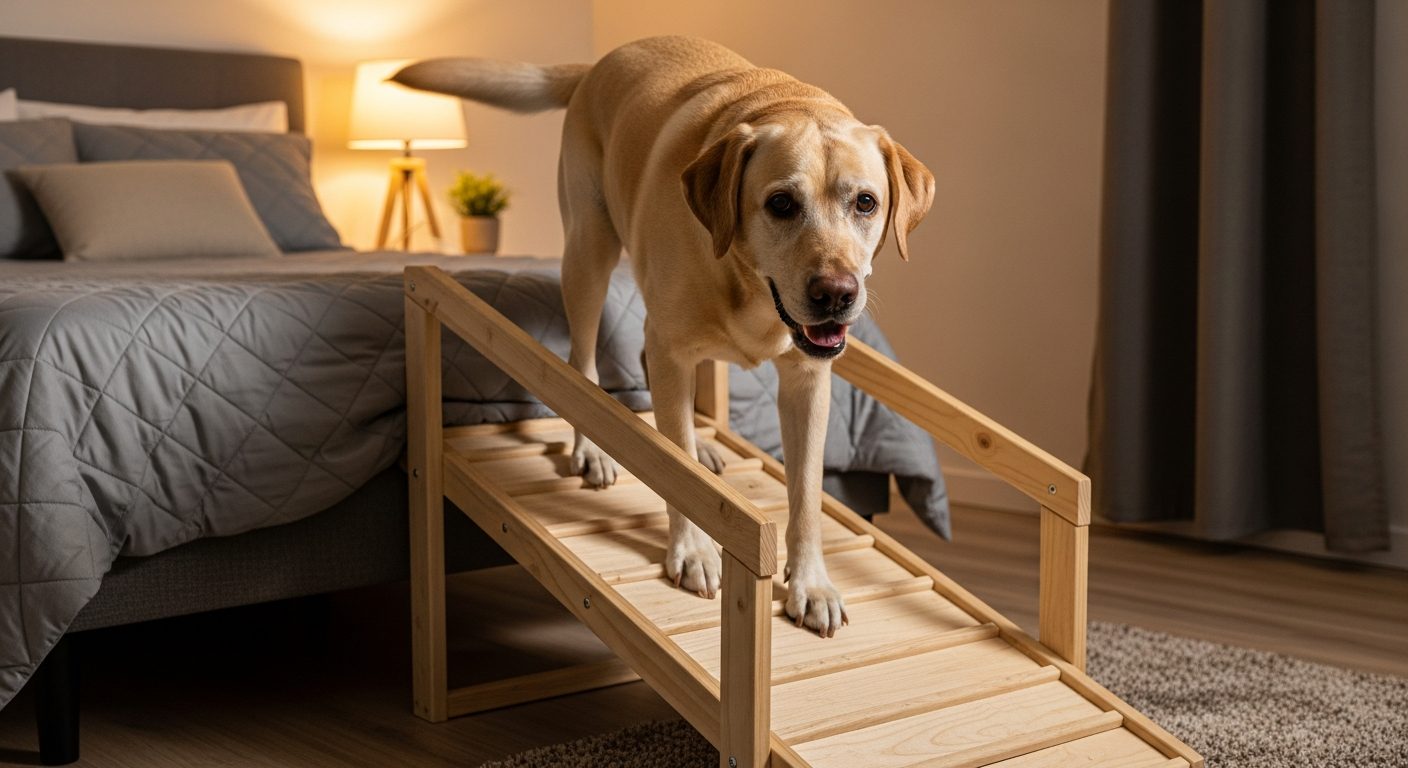
You need a ramp. But not just any ramp—you need one with a high-traction surface (not slippery carpet) and a gradual slope.
The "Gold Standard": DoggoRamps Bed Ramp for Large Dogs
- The Investment: It is pricey, but it is the best on the market. It is made of solid furniture-grade wood (so it doesn't wobble and scare the dog).
- Safety Feature: It features a special "PAWGRIP" anti-slip coating and has safety rails on the sides. If your dog gets dizzy or loses balance halfway up, the rail catches them.
The Car Alternative: PetSafe Happy Ride Telescoping Ramp
- Why: If you need something for the car to get to vet appointments, this is lightweight (aluminum) and telescopes out.
- Important: Do not make your senior dog jump out of an SUV; the impact on the spine is devastating.
Part 5: The Incontinence Station (Protecting Your Floors)
Let's talk about the reality nobody wants to discuss. A dog with dementia will have accidents.
They might forget they need to go out. They might forget how to ask. Or they might simply begin urinating while walking, unaware they are even doing it.
If you are ruining your hardwood floors with urine, or constantly screaming "NO!", you will eventually resent your dog. Don't let it get to that point. Acceptance is key.
The Fix: The Indoor Potty Solution
We set up an "emergency station" by the back door. When he couldn't make it outside in time, he learned to go on the pads.
Recommended: WizSmart Ultra XL Dog Pee Pads
- Why: Most generic pee pads are flimsy and slide around. These have adhesive tabs so they stick to the floor (so your dog doesn't slip on the pad itself).
- The Benefit: They turn liquid into gel instantly, trapping the ammonia smell so your house doesn't smell like a kennel.
For Male Dogs: Wegreeco Washable Male Dog Diapers (Belly Bands)
- Tip: Buy a 3-pack. You will always have one in the wash, one on the dog, and one drying.
- Lifesaver: They are machine washable and saved our sanity (and our sofas).
Part 6: Scent Mapping (The Invisible Guide)
This is a "pro tip" most people don't know, but it is based on solid veterinary science.
Since your dog's vision is failing (due to cataracts or neurological processing issues), they are effectively navigating in the dark. However, their nose is often the last sense to fade. You can use this to your advantage by creating a "Scent Map" of your home.
The Method
Use distinct, safe scents to mark different rooms. This helps the dog orient themselves ("Where am I?") without needing to see.
- Vanilla = Living Room (The "Safe/Social" zone)
- Lavender = Bedroom (The "Sleep" zone)
- Citrus = Danger Zones (Top of stairs, basement door)
You can use Plug-in Diffusers or just dab a little essential oil (make sure it is dog-safe!) on the doorframes at nose height. Over a few weeks, your dog creates a mental map. When they smell Lavender, their brain receives a chemical signal: "Ah, this is where I sleep," which can help reduce the panic pacing at night.
Part 7: Contrast and Visibility (The Eye Trick)
Dogs with dementia lose depth perception. A dark rug on a dark floor looks like a hole. A white wall meeting a white floor looks like an infinite void.
To help them navigate, you need to create High Contrast.
Quick Tips:
- Tape the Thresholds: Place a strip of blue painter's tape or a dark mat at the threshold of every doorway. This visual "marker" helps them understand they are crossing into a new room.
- Target the Water Bowl: If your dog stands in the kitchen barking because they can't find the water, place the bowl on a bright placemat (e.g., a blue mat on a white floor). This helps the bowl "pop" visually.
Summary: The "Barkitecture" Checklist
You don't have to renovate your entire house overnight. Start with the safety basics.
Your Weekend Action Plan:
- Safety First: Buy 3-4 cheap yoga mats and lay them in the high-traffic path from the bed to the outside door.
- Block the Traps: Use pool noodles or a retractable gate to block off the space behind the sofa and the TV.
- Upgrade Dining: Order an elevated feeder to help their digestion and neck pain.
- Light the Way: Install motion-sensor nightlights in the hallway (as discussed in our Dementia Signs Guide).
Your home might look a little cluttered for a while. You might have to explain the yoga mats to your guests. But seeing your old dog walk confidently across the room, tail wagging, without the fear of slipping? That peace of mind is beautiful.