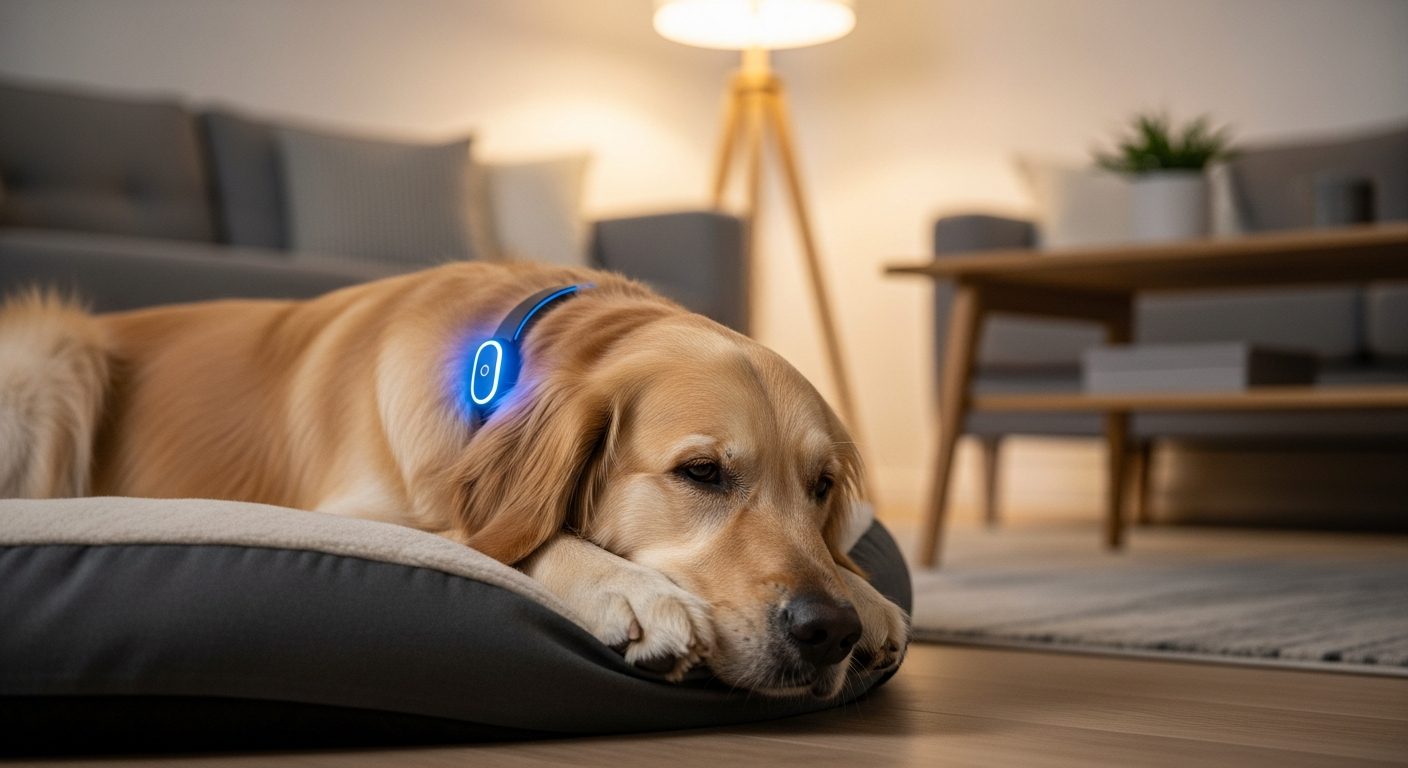
There is a moment—about 15 minutes before the thunderstorm actually hits—when my dog changes. He doesn't pant yet. He doesn't pace. To the naked eye, he looks asleep on the rug. But if I were to touch his chest, I would feel the thumping. A silent, internal drumbeat of rising panic.
By the time he is scratching at the door and drooling, it's too late. The cortisol has already flooded his brain. The medication won't work in time. I have lost the battle.
But what if I could see that invisible drumbeat?
In 2026, we don't have to guess. The same Heart Rate Variability (HRV) technology that athletes use to track recovery is now available for our dogs. And for owners of anxious or reactive dogs, this isn't just a gadget. It is a Crystal Ball.
We call it "Predictive Zen"—using data to catch the anxiety spike before the behavior starts, giving you a 15 to 20-minute window to intervene.
In this guide, I'm going to break down the science of canine HRV, review the top 3 wearables (PetPace, Whistle, Invoxia), and show you exactly how to use this data to stop a panic attack in its tracks.
In This Guide:
Part 1: The Science of Canine HRV
Before we dive into gadgets, let's understand what we are actually measuring.
What is Heart Rate Variability?
Your dog's heart doesn't beat like a metronome. There are tiny variations—milliseconds of difference—between each beat. This variation is called Heart Rate Variability (HRV).
Think of it this way:
- High HRV = The heart is flexible, responsive, and calm. The parasympathetic nervous system ("Rest and Digest") is in control. This is a resilient, recovered dog.
- Low HRV = The heart is rigid and stressed. The sympathetic nervous system ("Fight or Flight") has taken over. This is a dog preparing for danger.
The key insight is this: HRV drops before visible behavior changes.
When your dog hears the first rumble of thunder (even if it's too faint for your ears), their nervous system reacts instantly. Their HRV plummets. But their body hasn't caught up yet—they are still lying on the rug looking peaceful.
This is the 15 to 20-minute window. The window where medication can actually absorb. Where a calming protocol can work. Where you can get ahead of the storm instead of chasing it.
Why Does HRV Drop During Anxiety?
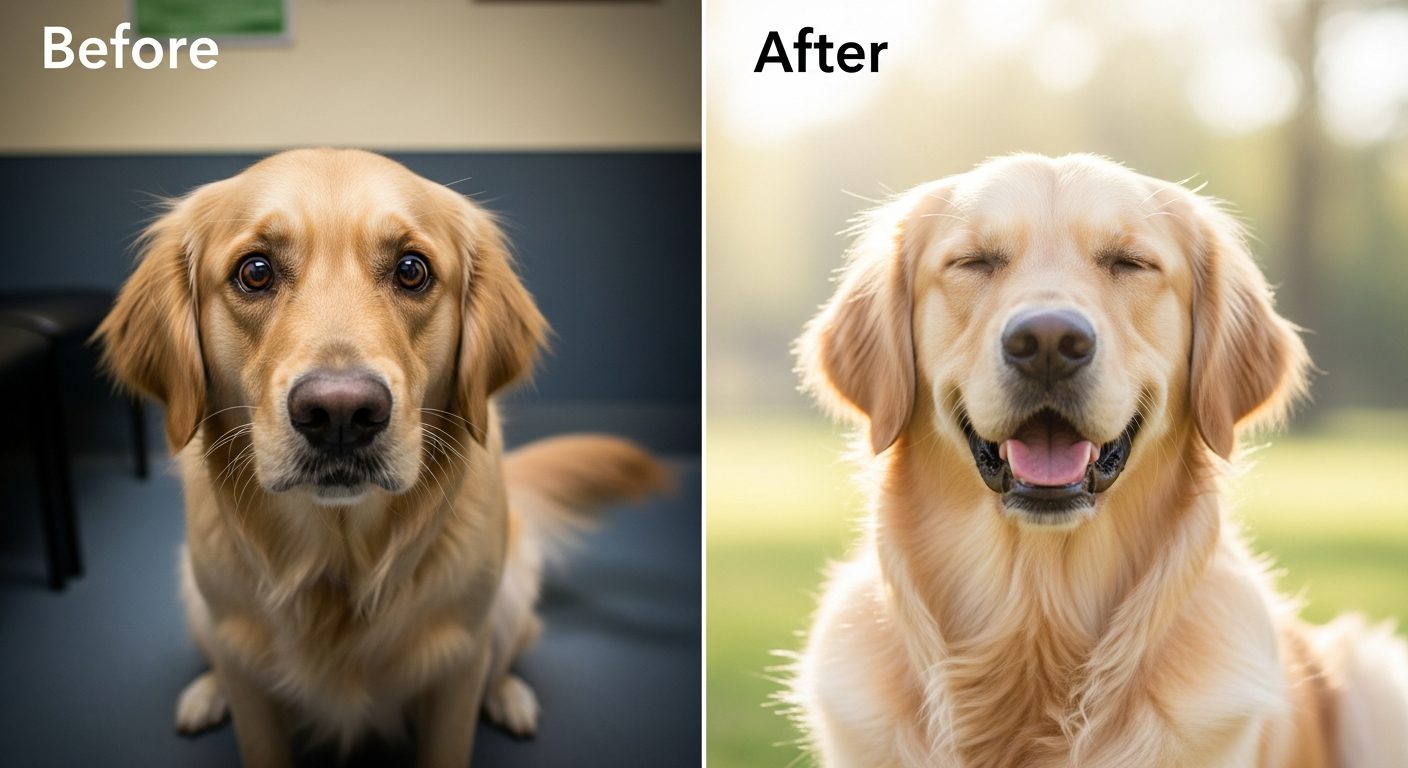
The Autonomic Nervous System (ANS) has two branches:
- Sympathetic ("Gas Pedal"): Increases heart rate, dilates pupils, shunts blood to muscles. Prepares for fight or flight.
- Parasympathetic ("Brake Pedal"): Slows heart rate, promotes digestion, encourages rest. The "Zen" state.
In a healthy, calm dog, these two systems constantly dance—speeding up and slowing down the heart in a flexible rhythm. This flexibility creates high HRV.
When anxiety hits, the Sympathetic system slams the gas pedal to the floor. The heart rate becomes rigid and fast. The "dance" stops, and HRV crashes.
This is why chronically anxious dogs often have lower baseline HRV than calm dogs. Their nervous system is always "on alert," never fully relaxing.
The Biomarker of Resilience
Researchers at veterinary cardiology centers now use HRV as a biomarker for overall health. Low HRV has been correlated with:
- Chronic stress and anxiety disorders
- Inflammatory conditions
- Cardiac disease risk
- Cognitive decline in senior dogs
- Reduced lifespan
Conversely, dogs with high HRV tend to be calmer, healthier, and more adaptable to new situations. HRV is essentially a "resilience score."
Part 2: Top 3 HRV Wearables Reviewed (2026)
Not all smart collars are created equal. Some track GPS and steps—basic Fitbit stuff. But true HRV monitoring requires medical-grade sensors that can detect those millisecond variations between heartbeats.
Here are the three contenders that actually deliver on the promise:
1. PetPace 3.0 — The Medical-Grade Monitor
Best For: Owners who want clinical-level data, dogs with diagnosed anxiety disorders, or senior dogs being monitored by a veterinarian.
The Technology: PetPace uses a non-invasive collar with embedded sensors that continuously track:
- Heart Rate and HRV
- Respiration rate
- Activity levels and posture
- Calories burned
- Temperature (for fever detection)
The Advantage: This is the collar used by veterinary hospitals and research institutions. The data quality is unmatched. You can share reports directly with your vet, and the app provides clinical-grade trend analysis.
The Drawback: It requires a monthly subscription for full analytics access, and the collar itself is pricier than consumer-grade options. It's not a "fun" tracker—it's a serious health monitoring tool.
Best Use Case: If your dog has been diagnosed with severe separation anxiety, storm phobia, or a cardiac condition, PetPace gives you and your vet the data needed to fine-tune medication timing and dosage.
2. Whistle Health — The Algorithm King
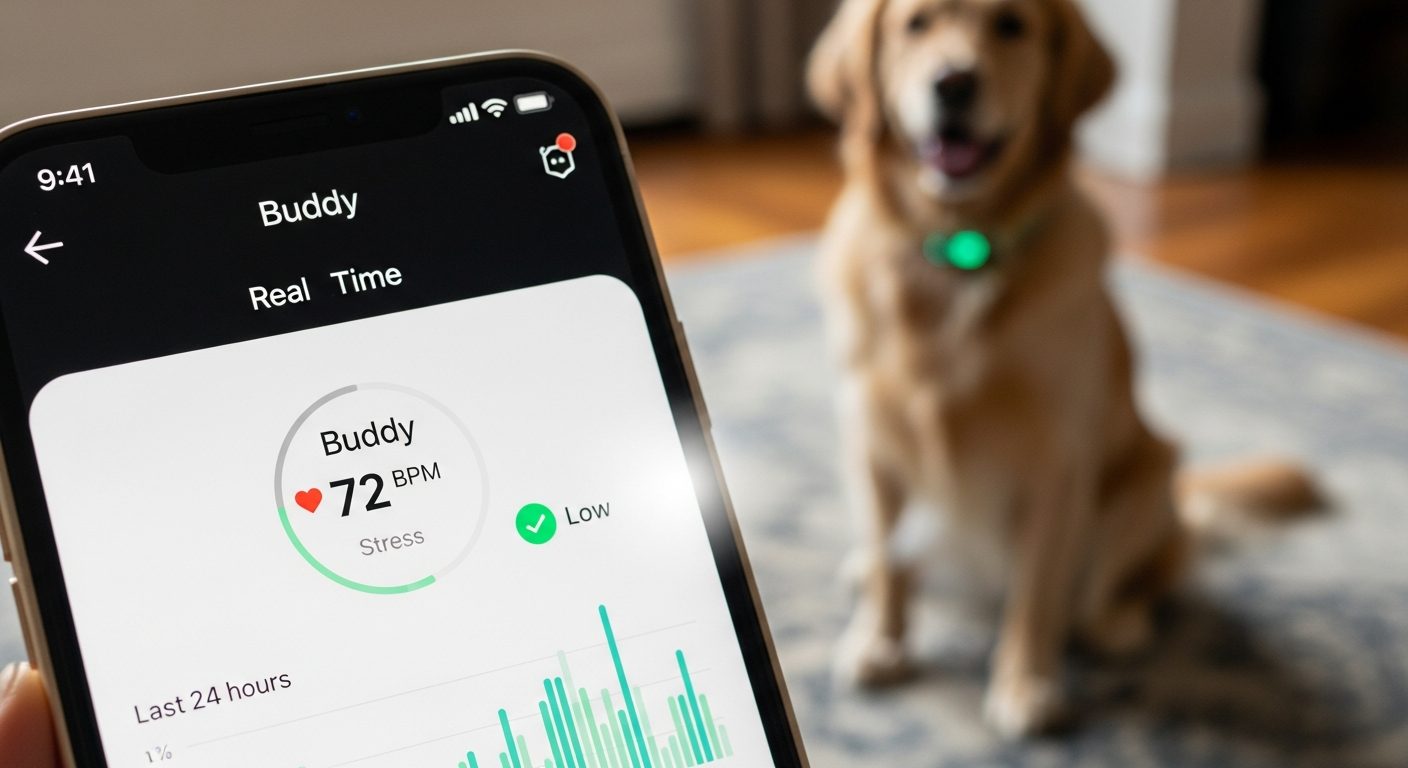
Best For: Everyday pet owners who want actionable insights without needing a veterinary degree to interpret the data.
The Technology: Whistle doesn't just track steps. It monitors:
- Licking and scratching frequency (early allergy detection)
- Sleep quality and disruptions
- Activity patterns
- A proprietary "Health Score" that acts as a simplified HRV-informed wellness metric
The Advantage: Whistle's algorithm is trained to detect anomalies. If your dog's baseline sleep pattern suddenly changes, or their scratching spikes, you get an alert—often days before symptoms become visible. The "Health Score" gives you a single number to track over time.
The Drawback: The HRV data is less granular than PetPace. You're getting "interpreted" insights rather than raw millisecond data. For most owners, this is actually easier to use, but data purists may want more.
Best Use Case: If you want a "set it and forget it" monitor that will ping your phone when something is off—before you even notice—Whistle is the most user-friendly option.
3. Invoxia Minitailz — The Cardio Specialist
Best For: Dogs with heart conditions, brachycephalic breeds prone to respiratory issues, or owners who want subscription-free monitoring.
The Technology: Invoxia comes from the human health wearable space and has applied their expertise to pets. It tracks:
- Heart rate and HRV with ECG-level accuracy
- Respiratory rate (crucial for breeds like Bulldogs and Pugs)
- Activity and rest patterns
- GPS location
The Advantage: Invoxia offers a subscription-free model for basic features. You pay once for the device and get lifetime access to core data. The respiratory tracking is particularly valuable for flat-faced breeds who can't regulate their breathing well during stress.
The Drawback: The app interface is less polished than Whistle's, and the "alert" system isn't as proactive. You'll need to check the data yourself rather than relying on push notifications.
Best Use Case: If your dog has a heart murmur, arrhythmia, or you're monitoring recovery from cardiac surgery, Invoxia gives you the cardio-specific data your vet needs.
Quick Comparison Table
| Feature | PetPace 3.0 | Whistle Health | Invoxia Minitailz |
|---|---|---|---|
| HRV Accuracy | Clinical-grade | Algorithm-interpreted | ECG-level |
| Best For | Vet-supervised care | Daily wellness tracking | Heart/respiratory issues |
| Subscription | Required | Required | Optional |
| Proactive Alerts | Yes | Yes (Best) | Limited |
| Ease of Use | Moderate | Easiest | Moderate |
Part 3: The "Predictive Zen" Protocol
Having the data is step one. Using it to actually prevent panic attacks is the real goal. Here's the exact protocol I developed after months of testing:
Step 1: Establish the Baseline (Week 1)
For the first 7 days, don't try to interpret anything. Just let the collar collect data during normal life.
You're looking for:
- Resting HRV: What is their HRV when they're sleeping peacefully at 2 AM?
- Active HRV: What happens during walks, playtime, and meals?
- Trigger HRV: If a known trigger happens (doorbell, stranger, car ride), how low does their HRV drop?
Write these numbers down. Your dog's "panic threshold" is unique to them. For my dog, a resting HRV of 45ms is calm. Below 30ms, we're entering the danger zone.
Step 2: Set the Silent Alarm (Week 2)
Most of these apps allow you to set custom alerts. Configure an alert for when HRV drops below your dog's "trigger threshold."
The Key: Set it lower than their "active" HRV but higher than their "panic" HRV. You want to catch the dip before they spiral, not after.
For example:
- Resting HRV: 45ms (calm)
- Active HRV: 35ms (walking, playing)
- Alert Threshold: 32ms
- Panic HRV: Below 25ms (full meltdown)
When you get that alert, the clock starts. You have approximately 15 to 20 minutes before visible symptoms emerge.
Step 3: The Pre-Emptive Strike
When the alert hits, execute your calming protocol immediately. This is not the time for training or correction. It's time for intervention.
My Protocol (in order):
- Fast-Acting Medication: If your vet has prescribed Sileo (dexmedetomidine) or Trazodone for acute anxiety, now is the time. These take 20-30 minutes to work—which is exactly why the early warning matters.
- Pressure Wrap: Get the Thundershirt on immediately. Constant pressure activates the parasympathetic system.
- Safe Space Activation: Guide them to their "den"—the crate, the bathroom, the closet—wherever they feel safest. Turn on white noise or calming music.
- Scent Anchor: If you use Adaptil (DAP) spray or diffuser, activate it now. The pheromones take 15 minutes to saturate the space.
- Your Energy: This is the hardest one. If you panic, they panic. Slow your breathing. Lower your voice. Project calm even if you don't feel it.
Step 4: The Result
When the storm arrives (literally or metaphorically), your dog is already wrapped, medicated, and in their safe space. The cortisol spike is blunted. The panic never fully ignites.
They might still be aware of the trigger. They might still be mildly stressed. But the difference between "mildly stressed" and "full-blown panic attack" is enormous—for their brain, their body, and their long-term health.
Every prevented panic attack is a deposit in the "resilience bank." Over time, the baseline HRV actually starts to improve because the nervous system isn't constantly getting flooded with cortisol.
Part 4: Case Study — The Decompression Test
To see how HRV monitoring works in practice, I ran a simple experiment with my storm-phobic dog, Max.
The Setup:
- Day 1: Thunderstorm forecast. No intervention. Let the panic happen (for data purposes only—I comforted him during).
- Day 8: Thunderstorm forecast. Full "Predictive Zen" protocol executed when HRV alert triggered.
Day 1 Results (No Intervention):
- 2:00 PM: HRV at 42ms. Calm, napping.
- 2:15 PM: HRV drops to 31ms. No visible change in behavior. (This was the missed window.)
- 2:30 PM: HRV crashes to 22ms. Panting begins. Pacing starts.
- 2:45 PM: Full panic. HRV unmeasurable (too much movement). Scratching at door, drooling, trembling.
- Recovery Time: 4 hours before HRV returned to baseline 40s.
Day 8 Results (Predictive Zen Protocol):
- 3:00 PM: HRV at 44ms. Calm.
- 3:12 PM: HRV alert triggers at 31ms. No visible symptoms yet.
- 3:13 PM: Sileo administered. Thundershirt applied. Moved to safe closet with white noise.
- 3:35 PM: Storm arrives. HRV holding at 28ms—elevated but not crashing.
- 3:50 PM: Storm peaks. HRV dips to 25ms. Mild panting, but no pacing. Stayed in safe space.
- 4:15 PM: Storm passes. HRV recovering to 35ms.
- Recovery Time: 45 minutes to return to baseline 40s.
The Difference:
Day 1: Full panic, 4-hour recovery, exhausted dog (and owner).
Day 8: Mild stress, 45-minute recovery, calm dog who took a nap afterward.
That 15-minute early warning changed everything.
Part 5: The Limitations (What HRV Can't Do)
I want to be honest about the boundaries of this technology. HRV monitoring is powerful, but it's not magic.
1. It Can't Replace Training
HRV monitoring is a management tool, not a cure. It tells you when your dog is about to panic—it doesn't teach them not to panic. Long-term improvement requires desensitization, counter-conditioning, and sometimes medication adjustments. The wearable helps you manage episodes while the training does the deeper work.
2. It Can't Predict Everything
HRV responds to physiological stress. If your dog has a sudden fear response to something novel (a new person, an unexpected sound), the HRV might drop at the same moment the behavior starts—no advance warning. The "predictive" advantage works best for known, gradual triggers like approaching storms, fireworks (you can hear them in the distance), or scheduled departures for separation anxiety.
3. It Requires Consistency
The collar needs to be worn consistently to establish an accurate baseline. If you only put it on before storms, the data will be incomplete and the algorithms less accurate. Treat it like a seatbelt—always on, just in case.
4. False Positives Happen
HRV can drop for reasons other than anxiety: physical exertion, digestion, illness, even dreaming during REM sleep. You'll learn to distinguish "playing hard" dips from "anxiety" dips over time, but expect some false alarms in the beginning.
FAQ: Common Questions About HRV Wearables
Q: What is HRV in dogs and why does it matter for anxiety?
A: HRV (Heart Rate Variability) measures the variation in time between heartbeats. High HRV indicates a calm, resilient dog with a responsive nervous system. Low HRV signals stress, inflammation, or an impending anxiety attack. When a dog's HRV drops significantly, it often predicts a panic episode 15-20 minutes before visible symptoms appear.
Q: Which smart collar is best for tracking dog anxiety?
A: For clinical-grade monitoring, PetPace 3.0 is the gold standard used by veterinary hospitals. For everyday pet owners who want the best algorithm-driven insights, Whistle Health offers excellent predictive alerts. For dogs with heart conditions, Invoxia Minitailz specializes in respiratory and heart tracking.
Q: How far in advance can HRV wearables predict a dog panic attack?
A: Most HRV wearables can detect the physiological changes that precede a panic attack 15-20 minutes before visible behavioral symptoms appear. Some owners report getting alerts up to 30 minutes before a thunderstorm triggers their dog's anxiety.
Q: Do I need a subscription for dog HRV smart collars?
A: It depends on the device. PetPace requires a monthly subscription for full analytics access. Whistle Health includes a subscription covering GPS and health monitoring. Invoxia Minitailz offers a subscription-free model for basic features.
Q: Can HRV monitoring help senior dogs with dementia?
A: Yes. Senior dogs with Canine Cognitive Dysfunction often experience increased anxiety and disrupted sleep patterns. HRV monitoring can detect Sundowning episodes before they escalate, track sleep quality, and help identify optimal times for medication or calming interventions.
Q: My dog hates wearing collars. Are there alternatives?
A: Some dogs tolerate harness-mounted sensors better than collars. PetPace offers a harness attachment option. For dogs that won't tolerate any wearable, you may need to rely on behavioral observation and scheduled medication protocols instead.
Summary: The Crystal Ball
For years, I felt helpless watching my dog suffer through panic attacks. By the time I saw the symptoms, it was already too late to help. The medication couldn't work fast enough. The Thundershirt couldn't calm a dog already in meltdown mode.
HRV monitoring gave me something I never had before: time.
Time to intervene. Time for medication to absorb. Time to create calm before the storm—literally.
This technology isn't about turning your dog into a science experiment. It's about giving them a chance to avoid suffering. Every panic attack avoided is a victory for their nervous system, their trust in you, and their long-term mental health.
The data doesn't lie. And when you can see the invisible drumbeat of anxiety rising in your dog's chest, you can finally do something about it.
The storm is coming. But now, you can see it first.