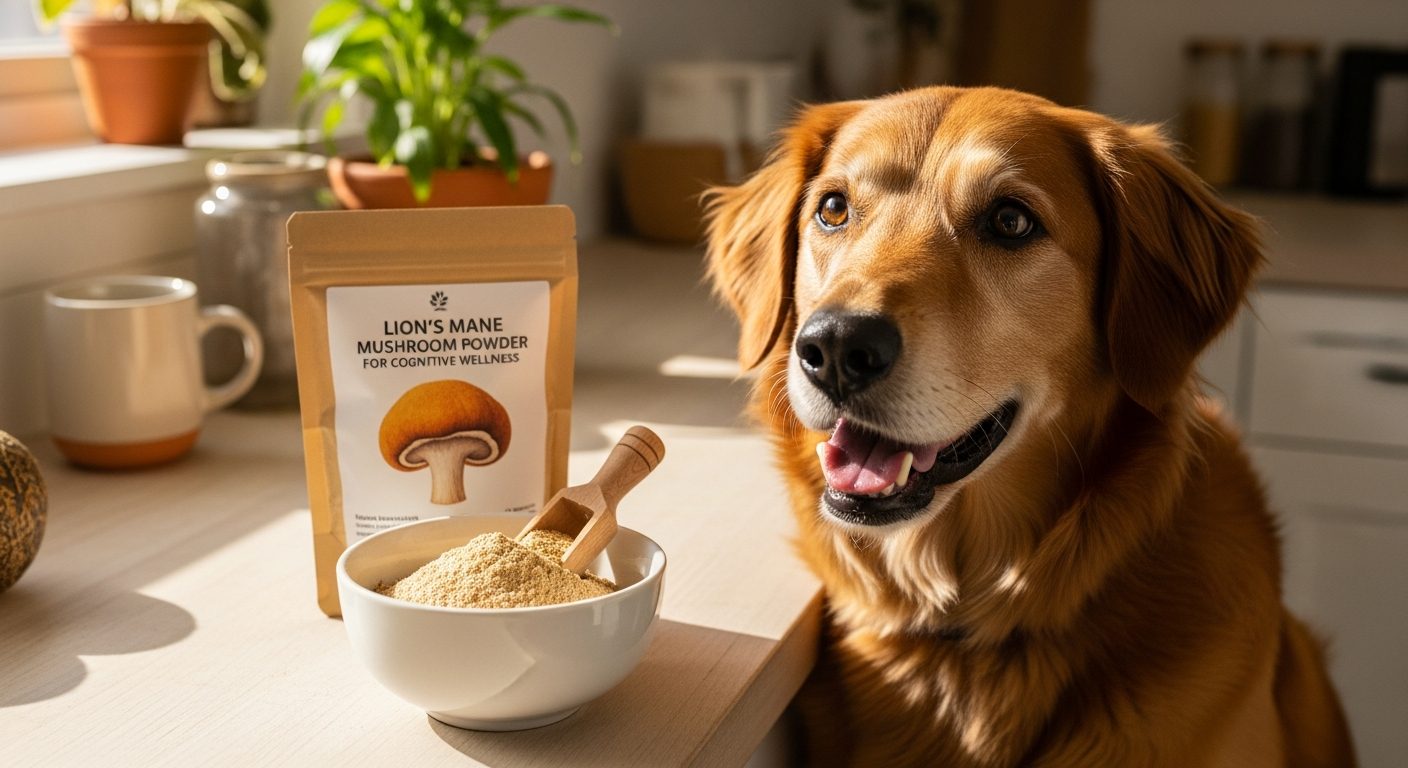
Ruby was a 12-year-old Golden Retriever who had lived in the same house for her entire life. One October morning, her owner let her out into the backyard—a yard she had patrolled for over a decade—and Ruby stopped at the bottom of the porch steps. She looked around, confused. She didn't recognize it. She just stood there, trembling, until her owner gently guided her back inside.
That was the moment Ruby's family knew something was wrong. It wasn't just "getting old." It was Canine Cognitive Dysfunction (CCD)—the dog equivalent of Alzheimer's disease.
For years, the treatment options for CCD were frustratingly limited. Selegiline (Anipryl) worked for some dogs, not others. Fish oil helped a little. Enrichment puzzles slowed the decline. But nothing seemed to reverse the fog.
Then Ruby's owner discovered Lion's Mane mushroom.
Within 8 weeks of daily supplementation, Ruby started recognizing her backyard again. She greeted her owner at the door—something she had stopped doing months ago. She slept through the night instead of pacing and whining.
Was it a miracle? No. It was science. And in 2026, Lion's Mane is quickly becoming the gold standard for canine brain health—a "functional mushroom" that doesn't just mask symptoms, but actually stimulates the regrowth of damaged neurons.
This guide will explain exactly how it works, who should use it, which brands are worth your money (and which are glorified rice flour), and the critical safety considerations every dog owner needs to know.
In This Guide:
- Part 1: What is a "Functional" Mushroom?
- Part 2: The Science of NGF (How Lion's Mane Repairs Brains)
- Part 3: Lion's Mane vs The Old Guard (Fish Oil, CBD)
- Part 4: Who Benefits Most?
- Part 5: The "Mycelium Trap" (How to Avoid Fake Products)
- Part 6: Top 3 Brands Compared
- Part 7: Safety, Dosage & Contraindications
- FAQ: Common Questions
Part 1: What is a "Functional" Mushroom?
Before we dive into Lion's Mane specifically, let's clear up some confusion about the term "functional mushroom."
A functional mushroom is not a psychedelic. It is not "magic mushrooms." It is a category of edible fungi that have been used in traditional medicine for centuries—primarily in Asian cultures—for their specific health benefits beyond basic nutrition.
The most well-known functional mushrooms include:
- Reishi: Known as the "Mushroom of Immortality." Primarily used for immune modulation and stress reduction.
- Chaga: A powerful antioxidant, often used for gut health and inflammation.
- Cordyceps: Used for energy and athletic performance (oxygen utilization).
- Turkey Tail: One of the most researched for immune support, especially in cancer protocols.
- Lion's Mane (Hericium erinaceus): The "Brain Mushroom." Unique for its ability to stimulate nerve growth.
What makes Lion's Mane stand out from this list is its mechanism of action. While most functional mushrooms work on the immune system or provide antioxidant protection, Lion's Mane is the only one proven to directly stimulate the production of Nerve Growth Factor (NGF)—a protein essential for the survival, maintenance, and regeneration of neurons in the brain.
This is not "woo-woo" herbalism. This is peer-reviewed neuroscience.
Part 2: The Science of NGF (How Lion's Mane Repairs Brains)
To understand why Lion's Mane is so exciting for dogs with cognitive decline, you need to understand NGF.
What is Nerve Growth Factor (NGF)?
NGF is a small protein that acts as a "fertilizer" for neurons. It was discovered in the 1950s by Rita Levi-Montalcini, who won the Nobel Prize for her work. NGF does three critical things:
- Promotes Neuron Survival: It prevents brain cells from dying prematurely.
- Stimulates Neuron Growth: It encourages neurons to sprout new connections (synapses).
- Supports Myelin Sheath Repair: Myelin is the protective coating around nerves. Damage to myelin is linked to diseases like Degenerative Myelopathy (DM) in dogs.
As dogs age, their natural production of NGF declines. This decline is directly correlated with the progression of Canine Cognitive Dysfunction. Less NGF = fewer healthy neurons = more confusion, anxiety, and disorientation.
How Does Lion's Mane Boost NGF?
Lion's Mane contains two families of unique compounds not found in any other food source:
- Hericenones: Found in the fruiting body (the "mushroom" part you see). These compounds stimulate NGF production in the brain.
- Erinacines: Found primarily in the mycelium (the root-like network). These are smaller molecules that can cross the Blood-Brain Barrier more easily.
The Blood-Brain Barrier (BBB) is a critical concept here. Many supplements fail because their active compounds are too large to cross the BBB. They might work in a petri dish, but they never reach the brain. Lion's Mane's erinacines are specifically small enough to penetrate this barrier, delivering NGF-boosting compounds directly to where they are needed.
The Research
While most clinical studies have been conducted on humans and mice, the findings are directly applicable to canine neurology:
- A 2009 Japanese study found that older adults with mild cognitive impairment who took Lion's Mane for 16 weeks showed significant cognitive improvement compared to placebo. When they stopped taking it, cognitive scores declined again.
- Multiple rodent studies have demonstrated that Lion's Mane can promote nerve regeneration after injury, including damage to the sciatic nerve.
- A 2020 study showed that Lion's Mane extract increased the expression of NGF and BDNF (Brain-Derived Neurotrophic Factor) in the hippocampus—the brain region responsible for memory.
For dogs suffering from CCD, this is groundbreaking. We are not just slowing decline; we are potentially rebuilding the neural infrastructure that has been damaged.
Part 3: Lion's Mane vs The Old Guard (Fish Oil, CBD)
If you've been managing your dog's cognitive health for a while, you've probably already tried fish oil (Omega-3s) and possibly CBD. How does Lion's Mane compare?
| Factor | Fish Oil (Omega-3) | CBD Oil | Lion's Mane |
|---|---|---|---|
| Primary Mechanism | Anti-inflammatory; supports cell membrane fluidity | Modulates endocannabinoid system; reduces anxiety | Stimulates NGF production; promotes neuron regeneration |
| Crosses Blood-Brain Barrier? | Partially (DHA does) | Yes | Yes (Erinacines) |
| Addresses Root Cause of CCD? | No (reduces inflammation only) | No (manages symptoms) | Yes (stimulates nerve regrowth) |
| Speed of Results | Slow (8-12 weeks) | Fast (1-2 hours for anxiety) | Moderate (4-8 weeks for cognitive effects) |
| Best For | General brain maintenance; inflammation | Anxiety; acute stress; pain | Cognitive decline; nerve damage; long-term brain health |
| Can Be Stacked Together? | Yes | Yes (with vet guidance) | Yes |
The Bottom Line: These supplements are not competitors—they are teammates. Fish oil provides the raw materials (DHA) for healthy cell membranes. CBD manages the behavioral symptoms of anxiety and confusion. Lion's Mane is the only one that actively tells the brain to grow new connections.
A comprehensive CCD protocol in 2026 often includes all three, working synergistically.
Part 4: Who Benefits Most?
Lion's Mane isn't just for dogs already diagnosed with dementia. Here are the key populations that see the most dramatic results:
1. Dogs with Canine Cognitive Dysfunction (CCD) & Sundowning
If your dog is pacing at night, staring at walls, getting "stuck" in corners, or failing to recognize family members, Lion's Mane should be a cornerstone of your protocol. The NGF stimulation directly addresses the underlying neurodegeneration.
What owners report: Reduced nighttime pacing (often within 4-6 weeks), improved recognition of family members, and a return of "spark" in their eyes.
2. Dogs with Nerve Damage (IVDD, Degenerative Myelopathy, FCE)
Lion's Mane's nerve-regenerating properties extend beyond the brain. Dogs recovering from:
- Intervertebral Disc Disease (IVDD): Ruptured discs that compress spinal nerves.
- Degenerative Myelopathy (DM): A progressive disease affecting the spinal cord, common in German Shepherds, Corgis, and Boxers.
- Fibrocartilaginous Embolism (FCE): A "spinal stroke" that causes sudden paralysis.
In these cases, Lion's Mane is being used as an adjunct to physical rehabilitation to encourage nerve regrowth. Some integrative veterinarians are now including it in post-surgical IVDD recovery protocols.
3. Reactive or Chronically Anxious Dogs
This one surprises people. What does a brain mushroom have to do with reactivity?
Emerging research suggests that chronic anxiety is, in part, a neurological issue—not just a behavioral one. Dogs with chronic stress have elevated cortisol, which literally shrinks the hippocampus over time. By promoting neuroplasticity (the brain's ability to form new connections), Lion's Mane may help anxious dogs "rewire" their fear responses more effectively, especially when combined with behavioral training.
It is not a sedative. It won't calm a panicking dog during a thunderstorm. But over months of consistent use, it may help reduce baseline reactivity.
4. Prevention in Middle-Aged Dogs (7+ Years)
You don't have to wait for symptoms. If your dog is entering their senior years (7+ for large breeds, 10+ for small breeds), proactive supplementation may help maintain cognitive reserve and delay the onset of CCD.
Part 5: The "Mycelium Trap" (How to Avoid Fake Products)

This is the most important section of this article. Most Lion's Mane supplements on the market are borderline scams.
Here's the dirty secret of the mushroom supplement industry:
The Problem: "Mycelium on Grain"
Growing a full Lion's Mane mushroom (the "fruiting body") takes time and expertise. It requires specific humidity, temperature, and substrate conditions. This is expensive.
So many supplement companies take a shortcut. Instead of growing the actual mushroom, they grow the mycelium (the root-like network) on cheap grain—usually rice or oats. Then they grind up the entire thing—mycelium AND grain—and put it in a capsule.
The result? A product that is 50-70% grain starch, with minimal actual medicinal compounds.
How to Spot the Fake Products
Look for these red flags:
- "Myceliated Grain" or "Mycelium Biomass": This is code for "we grew it on rice and didn't bother removing it."
- No Beta-Glucan Content Listed: Beta-glucans are the key medicinal compounds. If the label doesn't specify at least 20-30% beta-glucans, it's probably mostly filler.
- Made in USA (Ironically): Most high-quality fruiting body Lion's Mane is grown in Asia, where they have centuries of expertise. Many US companies use the cheaper mycelium-on-grain method.
- Suspiciously Cheap: Real Lion's Mane extract costs money to produce. If it's $10 for 90 capsules, it's rice flour.
What to Look For
- "100% Fruiting Body": This means the actual mushroom, not the mycelium.
- Beta-Glucan Content >25%: This confirms the presence of active medicinal compounds.
- "No Grain" or "No Fillers": Explicit confirmation they didn't grind up the growing substrate.
- Third-Party Testing: COA (Certificate of Analysis) available for heavy metals and potency.
- Hot Water Extraction: This method is necessary to break down the tough chitin cell walls of mushrooms and release the beta-glucans.
Part 6: Top 3 Brands Compared (2026)
After extensive research and community feedback, here are the three brands that consistently meet the quality criteria for canine use:
| Brand | Type | Beta-Glucans | Form | Best For | Price (approx) |
|---|---|---|---|---|---|
| Real Mushrooms | 100% Fruiting Body | >25% | Powder (Pet-specific formula) | Best overall; vetted for pets | $30-35/60g |
| Four Leaf Rover | 100% Fruiting Body | >30% | Powder (Organic) | Premium quality; gut-health focus | $40-45/50g |
| Super Snouts | 100% Fruiting Body | >20% | Powder | Budget-friendly; widely available | $25-30/75g |
Our Top Pick: Real Mushrooms Lion's Mane for Pets
Why We Recommend It:
- 100% organic fruiting body—no mycelium, no grain, no fillers.
- Verified >25% beta-glucans with third-party testing.
- Specifically formulated for pets with dosing guidelines by weight.
- Hot water extracted for maximum bioavailability.
- The company was founded by mycologists (mushroom scientists), not marketers.
Four Leaf Rover: The Premium Option
If budget is no concern, Four Leaf Rover offers an exceptional product with slightly higher beta-glucan content and a focus on organic, wild-crafted sourcing. They also combine their Lion's Mane with other gut-supportive ingredients, which is ideal if your dog has digestive issues alongside cognitive decline (remember: the gut-brain axis is real).
Super Snouts: The Budget-Friendly Choice
Super Snouts offers good value for pet owners on a budget. While the beta-glucan content is slightly lower than Real Mushrooms, it is still a legitimate 100% fruiting body product—not mycelium-on-grain junk.
Part 7: Safety, Dosage & Contraindications
Lion's Mane has an excellent safety profile, but there are important considerations:
General Dosing Guidelines
Most pet-specific Lion's Mane products come with weight-based dosing instructions. A general guideline for powder supplements:
- Small dogs (under 20 lbs): 250-500 mg daily
- Medium dogs (20-50 lbs): 500-750 mg daily
- Large dogs (50-100 lbs): 750-1000 mg daily
- Giant breeds (100+ lbs): 1000-1500 mg daily
How to Give It: Mix the powder into wet food or sprinkle over kibble. It has a mild, slightly sweet taste that most dogs accept easily.
When to Give It: Consistency matters more than timing. Once daily with a meal is standard. Some owners split the dose between morning and evening.
How Long Until Results?
NGF stimulation and nerve regeneration take time. Expect:
- 2-4 Weeks: Possible subtle improvements in energy or alertness.
- 4-8 Weeks: Noticeable cognitive improvements (reduced pacing, better recognition).
- 3-6 Months: Maximum benefit; this is a long-term supplement, not a quick fix.
Contraindications & Cautions
1. Auto-Immune Conditions: Because Lion's Mane modulates the immune system (through beta-glucans), use caution in dogs with autoimmune diseases like Immune-Mediated Hemolytic Anemia (IMHA) or Lupus. Consult your vet first.
2. Diabetes: Lion's Mane may have blood sugar-lowering effects. If your dog is diabetic, monitor glucose levels closely when starting supplementation.
3. Upcoming Surgery: Due to potential effects on blood clotting, discontinue Lion's Mane at least 2 weeks before any scheduled surgery.
4. Allergies: Dogs with known mushroom allergies should avoid Lion's Mane. Start with a small dose and monitor for any signs of allergic reaction (itching, swelling, digestive upset).
5. Pregnancy/Nursing: Insufficient data. Avoid during pregnancy and lactation.
Drug Interactions
Lion's Mane is generally safe to combine with most medications, but inform your vet if your dog is taking:
- Blood thinners (Warfarin, Aspirin)
- Diabetes medications (Insulin, Metformin)
- Immunosuppressants (Prednisone, Cyclosporine)
FAQ: Common Questions About Lion's Mane for Dogs
Q: Is Lion's Mane safe for long-term use?
A: Yes. There is no evidence of toxicity with prolonged use. In fact, the benefits appear to be cumulative—the longer you give it, the more pronounced the effects. Most owners consider it a lifetime supplement for senior dogs.
Q: Can I give my dog human Lion's Mane supplements?
A: Technically yes, if the product is 100% fruiting body with no additives. However, human capsules may contain ingredients like silica or magnesium stearate that are unnecessary for dogs. Pet-specific formulas are preferable and come with appropriate dosing.
Q: Will it make my dog sleepy or "high"?
A: Absolutely not. Lion's Mane is not psychoactive. It does not contain psilocybin or any other mind-altering compound. Your dog will not act "stoned." If anything, owners report increased alertness and engagement.
Q: Can I give it to my young, healthy dog?
A: While there's no harm in it, Lion's Mane is most beneficial for dogs over 7 years old or those with specific neurological concerns. For young, healthy dogs, focus on a quality diet and exercise. Save the supplements for when they need them.
Q: My dog is already on Selegiline (Anipryl). Can I add Lion's Mane?
A: In most cases, yes. They work through different mechanisms. Selegiline increases dopamine, while Lion's Mane stimulates NGF. Many integrative vets use them together. However, always confirm with your prescribing veterinarian.
Q: How do I know if it's working?
A: Keep a journal. Note specific behaviors: How many times did she pace last night? Did she recognize me when I came home? Did she get stuck in the corner today? After 8 weeks, compare your notes. The improvements are often subtle but measurable.