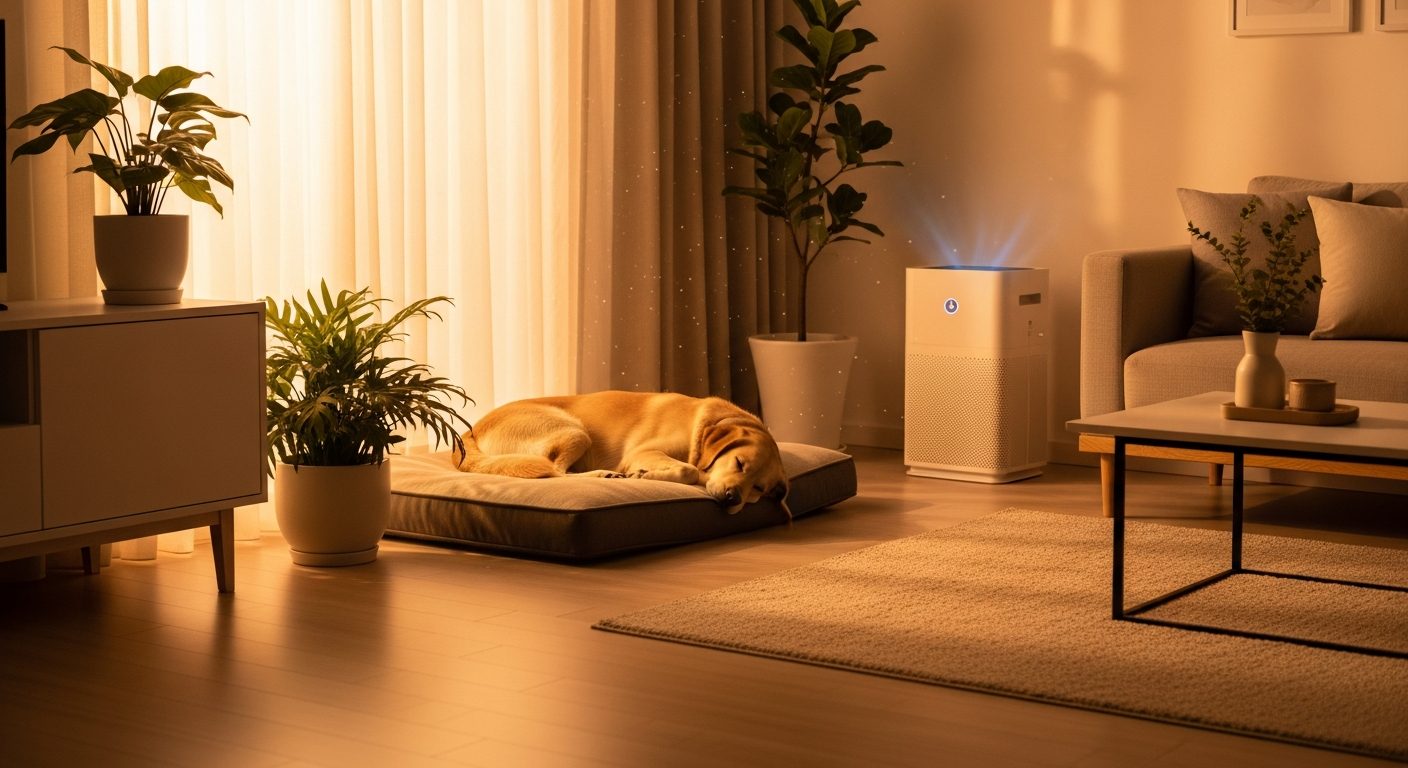
You adopted a rescue dog six months ago. You have done everything "right." Positive reinforcement. Consistent routines. Expensive trainers. The vet says she is healthy. And yet, every evening at 6pm, she paces, pants, and stares at the wall like she is seeing ghosts.
The problem is not your dog. The problem is your house.
Rescue dogs carry invisible scars. Trauma is stored in their nervous system, making them hypersensitive to environmental triggers that we—with our dull human senses—cannot even perceive. The flickering of an LED bulb. The off-gassing of a new couch. The ultrasonic hum of a cheap electronics charger.
These "invisible stressors" are constantly tickling their already-overloaded threat detection system. The result? Chronic cortisol elevation that no amount of training can fix.
In 2026, the cutting edge of canine behavior science is shifting from "Train the Dog" to "Detox the Environment." We call this the Zen Home Protocol—a room-by-room sensory audit that removes the invisible enemies attacking your dog's peace.
In This Guide:
- Part 1: The Invisible Enemy (Indoor Air Quality)
- Part 2: Auditory Detox (The Science of Brown Noise)
- Part 3: The Visual Environment (Flicker Fusion & Blue Light)
- Part 4: The Tactile Environment (Safe Zones & Dens)
- Part 5: The 7-Day Sensory Reset Protocol
- Case Study: Barnaby the "Untrainable" Terrier
- Conclusion: Biology Before Behavior
Part 1: The Invisible Enemy — Indoor Air Quality
Your dog's nose is not just "better" than yours. It is a completely different organ operating on a different plane of reality.
The Super-Nose Anatomy
A human has approximately 6 million olfactory receptors. Your dog has up to 300 million. More importantly, the part of the canine brain dedicated to analyzing smells is—proportionally—40 times larger than yours.
This means that when you walk into a room and smell "nothing," your dog is smelling:
- The formaldehyde off-gassing from your new IKEA bookshelf.
- The phthalates in your vinyl flooring.
- The volatile organic compounds (VOCs) in your scented candle.
- The residue of the cleaning spray you used three days ago.
- The old urine stain under the carpet that you "cleaned" but didn't enzymatically neutralize.
To your dog, your living room is not neutral. It is a chemical soup.
VOCs and Neuroinflammation
Volatile Organic Compounds (VOCs) are chemicals that evaporate at room temperature. Common household sources include:
- Furniture: Pressed wood, particle board, and foam cushions off-gas formaldehyde.
- Cleaning Products: Bleach, ammonia, and synthetic fragrances.
- Scented Products: Candles, plug-in air fresheners, and essential oil diffusers (yes, even "natural" ones).
- Flooring: New carpet, vinyl, and laminate release adhesives and plasticizers.
When a dog inhales these chemicals, they don't just irritate the lungs. They cross the blood-brain barrier through the olfactory nerve—a direct highway from the nose to the brain.
The result? Neuroinflammation. The same low-grade brain inflammation linked to anxiety, aggression, and cognitive decline in humans is now being studied in chronically stressed dogs. A rescue dog with an already-sensitized nervous system is like a house fire waiting for a spark. VOCs are the spark.
The Olfactory Detox Protocol
You cannot eliminate all VOCs. But you can dramatically reduce the load on your dog's system with these steps:
Step 1: Eliminate Synthetic Fragrances
This is non-negotiable. Remove all plug-in air fresheners, scented candles, and synthetic "fresh linen" sprays. Your idea of a "pleasant" smell is a chemical assault on your dog's brain. If you must have scent, use a single, high-quality essential oil (lavender is proven calming) in a water-based diffuser for no more than 30 minutes, in a ventilated room, with the dog able to leave.
Step 2: Upgrade Your Air Filtration
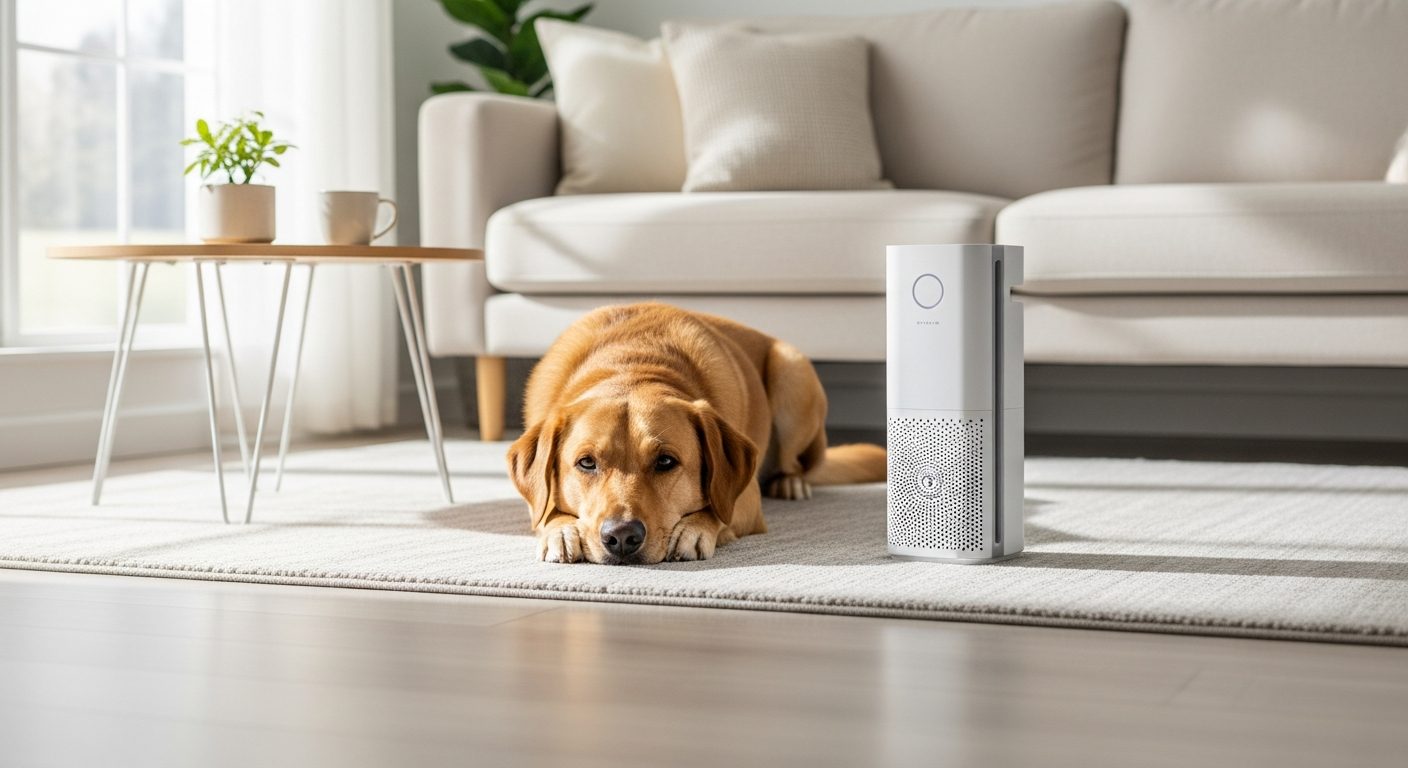
A standard HVAC filter catches dust, not chemicals. You need a True HEPA filter with an Activated Carbon layer. The HEPA captures particulate matter (dander, pollen), and the carbon adsorbs gaseous VOCs. Place one in the room where your dog spends the most time.
Step 3: Switch to Unscented Cleaning
The lemon-fresh floor cleaner is not your friend. Use unscented, enzyme-based cleaners. For pet messes, enzymatic cleaners break down the organic compounds in urine and feces so your dog doesn't smell the ghost of an old accident and feel the need to "mark over it."
Step 4: Ventilate New Items
Bought a new dog bed? A new couch? Let it off-gas in the garage for 48-72 hours before bringing it into the main living space. New furniture releases the most VOCs in the first few days.
Part 2: Auditory Detox — The Science of Bioacoustics
If the nose is the first line of sensory assault, the ears are the second. Dogs can hear frequencies between 40 Hz and 60,000 Hz. Humans top out around 20,000 Hz.
This means your dog is constantly hearing things you are not. The ultrasonic whine of a phone charger. The high-pitched buzz of an LED dimmer switch. The distant siren that hasn't reached your ears yet.
Why White Noise Fails
Many well-meaning owners play "White Noise" to mask environmental sounds. It rarely works. Here's why:
White noise contains all frequencies at equal intensity. It is "noisy" in the truest sense. For a sound-sensitive dog, white noise often adds to the auditory clutter rather than calming it. It can feel "scratchy" and chaotic to their sensitive ears.
The Brown Noise Solution
Brown noise (sometimes called Red Noise) is different. It has stronger energy at lower frequencies and decreases in power as frequency increases. It sounds like a deep, rumbling thunder or a powerful waterfall.
Why dogs love it:
- It masks high-frequency sounds (the ones that startle them) more effectively because the low frequencies "fill up" the auditory space.
- The low rumble mimics the reassuring sounds of nature—wind, distant thunder, the mother's heartbeat in the den. It is evolutionarily calming.
- It promotes "Entrainment." The brain's electrical activity tends to synchronize with rhythmic external sounds. Low-frequency brown noise encourages the brain to drop into slower, calmer Alpha and Theta wave states.
The Reggae Effect
A 2017 study at the University of Glasgow found that dogs in kennels showed significantly reduced stress behaviors when listening to Reggae and Soft Rock, more than any other genre.
Why Reggae? The theory is tempo and rhythm. Reggae typically has a tempo of 60-90 BPM, which is close to a resting dog's heartbeat (60-100 BPM for large dogs). The steady, predictable rhythm promotes cardiac and respiratory entrainment—literally slowing the dog's body down to match the music.
The Soundscape Protocol
Step 1: Create a "Sound Sanctuary"
Designate one room as the low-stimulation zone. This is where your dog retreats during stressful times (storms, fireworks, when you leave for work). Play brown noise or species-specific classical music (like "Through a Dog's Ear") consistently in this room.
Step 2: Audit Your Electronics
Walk through your house with an app that detects high-frequency sounds (many are available for smartphones). Identify the "buzzy" offenders—cheap LED bulbs, older TVs, certain chargers. Replace them with higher-quality electronics that don't emit ultrasonic whines.
Step 3: Use Predictable Sound Transitions
Sudden silence can be as startling as sudden noise. If you are leaving the house, don't go from TV playing to dead silence. Instead, leave the brown noise or calming music playing at a consistent, low volume. This provides an "auditory blanket" that muffles the startling sounds of the world outside.
Part 3: The Visual Environment — Flicker Fusion and Blue Light
Humans see the world at approximately 60 frames per second (fps). This is why movies filmed at 24 fps look smooth to us—our brain fills in the gaps.
Dogs have a higher "Flicker Fusion Rate"—estimated at 70-80 fps or higher. This means that what looks like a solid image on your TV screen to you might look like a rapidly flickering slideshow to your dog. What looks like a steady LED light might be pulsing noticeably to them.
The Blue Light Problem
Modern LED bulbs and screens emit a high proportion of blue light. Blue light suppresses melatonin production—the hormone that signals "time to sleep." For a dog already struggling with evening anxiety (a common symptom of chronic stress), a house bathed in blue-rich LED light after sunset is chemically telling their brain to stay alert.
Visual Hygiene Solutions
Step 1: Switch to Incandescent or Warm LEDs
In the evening hours (after 6pm), switch to bulbs with a color temperature of 2700K or lower (often labeled "Warm White" or "Soft White"). These emit less blue light and mimic the natural sunset spectrum.
Step 2: Reduce Screen Time Near the Dog
If your dog's bed is right next to the TV, consider moving it. The flickering screen, combined with the blue light, is a double dose of visual stress. If the dog chooses to be near you while you watch TV, that is fine. But give them an "escape route" to a darker, calmer area.
Step 3: Avoid Flashing/Strobing Lights
This seems obvious, but it extends to things like decorative string lights with a "twinkle" setting or smart bulbs programmed to change colors. To your dog, these are not festive; they are erratic and unpredictable.
Step 4: Natural Light Exposure During the Day
Counteract the evening light reduction by maximizing natural sunlight during the day. Open the blinds. Let the dog sunbathe. This helps regulate their circadian rhythm, making the transition to dim evening lighting feel natural rather than jarring.
Part 4: The Tactile Environment — Safe Zones and the Den Instinct
A stressed dog is a dog looking for a safe cave. This is a primal instinct. In the wild, canids seek out dens—enclosed, dark, protected spaces—when threatened or vulnerable.
Den vs. Crate: The Difference
A crate can be a den, but a crate is not automatically a den. Many dogs associate the crate with confinement, separation, or punishment. A true "den" is:
- Chosen: The dog can enter and exit freely. It is never forced.
- Enclosed: It has walls on at least three sides, ideally with a "roof" or draped cover.
- Cozy: It has soft, washable bedding that smells like the dog (or the owner).
- Located: It is placed in a quiet corner, away from high-traffic areas, but still within sight of the family "hub."
Creating the Perfect Safe Zone
Option 1: The "Under the Table" Den
Many dogs naturally gravitate under desks or dining tables. You can formalize this by draping a blanket over a table to create a cave-like enclosure and placing their bed underneath.
Option 2: The Open Crate
If your dog already uses a crate, remove the door (or zip-tie it permanently open). Drape a dark blanket over the top and sides, leaving only the front open. This transforms the "cage" into a "cave."
Option 3: The Corner Fortress
Use two pieces of furniture (like a couch and a bookshelf) to create a corner nook. Add an orthopedic bed and a low-light lamp on a timer. This becomes the dog's dedicated "decompression station."
Pro Tip: Place a worn t-shirt of yours in the den. Your scent is profoundly calming. For dogs with separation anxiety, this can be the difference between panic and peace.
Part 5: The 7-Day Sensory Reset Protocol
You now understand the four pillars: Air, Sound, Light, and Touch. But how do you implement this without overwhelming yourself (and your dog)?
Here is a simple, one-week protocol to "reboot" your home environment:
Day 1: The Olfactory Purge
Walk through every room. Remove all plug-in air fresheners, scented candles, and synthetic sprays. Box them up. Get them out of the house entirely. Open windows for 30 minutes to flush the air.
Day 2: The Air Upgrade
Order or install a True HEPA + Activated Carbon air purifier in your dog's primary living space. Run it on a medium setting 24/7.
Day 3: The Sound Audit
Identify one room to designate as the "Sound Sanctuary." Set up a speaker or sound machine to play brown noise or calming classical music. Play it consistently—not just during storms, but as a baseline "audio wallpaper."
Day 4: The Light Shift
Replace the bulbs in the evening living areas with 2700K warm-white LEDs. If you have smart bulbs, program them to shift to warm tones after 6pm automatically.
Day 5: The Den Build
Create or enhance your dog's safe zone. Add a blanket cover, fresh bedding, and a worn piece of your clothing. Make it cozy and enclosed.
Day 6: The Electronics Audit
Use a high-frequency sound detector app to identify "buzzy" electronics. Unplug or replace the worst offenders. Pay special attention to areas where your dog rests.
Day 7: Observation and Adjustment
Spend this day simply watching. Is your dog using the new den? Does she seem calmer in the Sound Sanctuary? Is the evening pacing reduced? Take notes. The data you gather this week will guide your next steps.
Case Study: Barnaby the "Untrainable" Terrier
Barnaby was a 4-year-old Jack Russell Terrier mix surrendered to a rescue after his owners declared him "untrainable." His file read like a horror novel: incessant barking, destructive chewing, unpredictable snapping, and nightly pacing that kept the foster home awake until 2am.
Three trainers had tried. Two prescribed medications. Nothing worked.
When Barnaby's new adopter, a veterinary technician named Maria, brought him home, she didn't start with training. She started with a sensory audit.
What she found:
- A plug-in air freshener in every room ("Ocean Breeze" scent).
- A cheap LED strip light flickering at a frequency invisible to humans but maddening to dogs.
- A TV left on 24/7 "for company," playing erratic cable news with sudden loud noises.
- A wire crate in the corner that Barnaby refused to enter.
The changes she made:
- Removed all air fresheners. Ran a HEPA purifier for a week.
- Replaced the LED strip with warm-toned lamps.
- Replaced the TV with a dedicated brown noise machine.
- Converted the crate to an open den with a blanket roof and her old hoodie inside.
The results:
Within 72 hours, Barnaby voluntarily entered his new "den" for the first time. By day 5, the nightly pacing stopped. By week 2, the barking had reduced by 80%. Maria reported that Barnaby would now "sigh and lie down" instead of "vibrate and stare."
No new training. No new medications. Just a change in the invisible environment.
"He wasn't untrainable," Maria said. "He was overstimulated. We were torturing him with our 'normal' home, and we didn't even know it."
Conclusion: Biology Before Behavior
We have spent decades treating dog anxiety as a behavioral problem. We hire trainers. We buy puzzle toys. We medicate. And when those things don't work, we blame the dog—or worse, we surrender them back to shelters.
The Zen Home approach flips the script. Before you ask "What is wrong with my dog?", ask "What is wrong with my dog's environment?"
The air they breathe. The sounds they hear. The light they see. The textures they feel. These are not luxuries. They are the biological foundations of a calm nervous system.
A rescue dog comes to you with a nervous system already set to "high alert." Every synthetic fragrance, every flickering light, every ultrasonic whine is a micro-assault on their already-fragile sense of safety.
Your job is not to force them to calm down. Your job is to create an environment where calmness is the natural state.
Detox the home. The dog will follow.