I watched my dog walk past his food bowl three times last Tuesday. He was hungry—I could hear his stomach growling from across the kitchen. He walked up to the metal dish, sniffed the brown pebbles, and looked at me with a hollow, confused expression. He didn't know what to do. He had forgotten that this was food.
That was the moment the reality of Canine Cognitive Dysfunction (CCD) hit me harder than any vet diagnosis.
For years, I had focused on his body. I bought the expensive joint chews for his hips. I bought the grain-free kibble for his coat. But standing there in the kitchen, coaxing him to take a single bite, I realized I had made a terrible mistake.
I wasn't just feeding him wrong. I was starving the only part of him I had left—his mind.
In This Guide:
Part 1: The "Biological Rust" (Why Your Current Food Might Be Hurting)
I used to think "Premium" kibble was enough. I was wrong.
Most commercial dog food—even the expensive stuff—is processed at extremely high heat. This cooking process creates chemical compounds called AGEs (Advanced Glycation End-products).
Think of AGEs as "biological rust."
When a young, healthy dog eats kibble, their liver and kidneys filter this "rust" out efficiently. But as a dog ages, their filtration system slows down. The rust starts to accumulate. It creates chronic inflammation that travels through the blood and crosses the barrier into the brain.
Part 2: The "Bright Mind" Breakthrough
Around 2015, Purina (with Nestlé's research dollars) released a dog food that made a specific, science-backed claim: It could help dogs think better. The product was Purina Pro Plan Bright Mind.
I was skeptical at first. But my dog was pacing at night, getting stuck in corners, and staring at walls. So, I dug into the actual research behind the bag.
The Key Ingredient: MCTs
Bright Mind's formula contains enhanced botanical oils that provide Medium-Chain Triglycerides (MCTs). These MCTs are converted by the liver into ketones—an alternative fuel source that even a damaged brain can use.
In Purina's own studies, dogs over age 7 fed this formula showed measurable improvements in alertness, attentiveness, and memory within 30 days.
Part 3: The Budget Tiers of Brain Food
I won't pretend everyone can afford the same food. Here are the tiers:
Tier 1: The Budget Option ($40-$50/month)
If you can afford nothing else, keep your current senior food and add pure MCT oil to every meal. (See our Supplement Stack Guide)
Tier 2: The Mid-Range Option ($60-$80/month)
Switch to Purina Pro Plan Bright Mind Adult 7+. It's specifically formulated for cognitive support with botanical oils.
Tier 3: The Premium Option ($100+/month)
Consider fresh, gently cooked food delivery services. These minimally processed foods have lower AGE levels and higher bioavailability of nutrients.
Part 4: The "Brain Toppers" (Daily Add-Ons)
Regardless of which tier you choose, you can supercharge the brain-boosting power with simple "toppers" added to each meal.
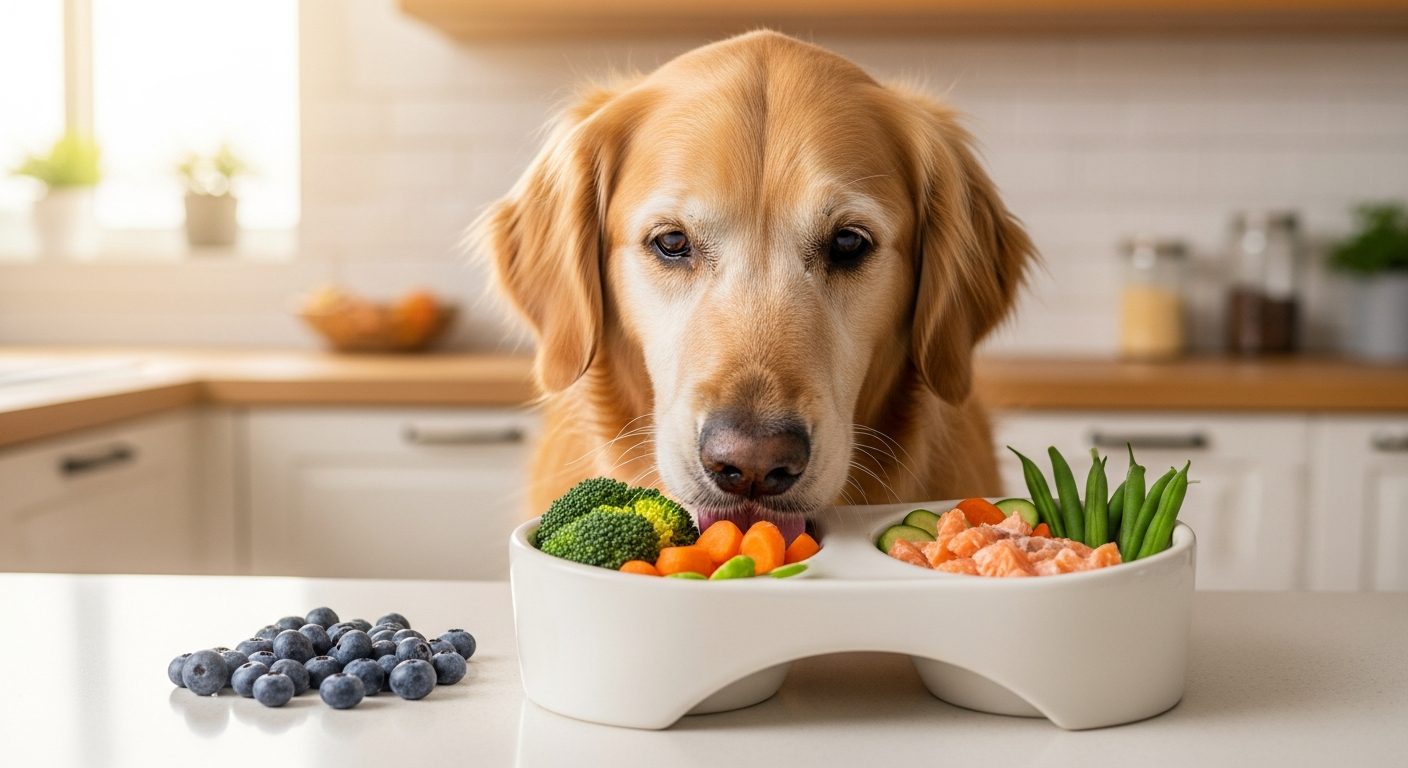
Topper #1: Sardines (The Omega Bomb)
- Why: Wild-caught sardines are one of the richest sources of Omega-3 fatty acids (DHA and EPA). They are low on the food chain, so they have minimal heavy metal contamination.
- How: Add 1-2 small sardines (packed in water, NOT oil) to their food 3 times a week. Mash them up with a fork.
Topper #2: Blueberries (The Antioxidant Shield)
- Why: Blueberries are one of the most antioxidant-rich foods on Earth. They fight the "biological rust" (oxidative stress) that damages brain cells.
- How: Add 5-10 fresh or frozen blueberries to their meal daily. Mash them slightly so they can absorb the nutrients.
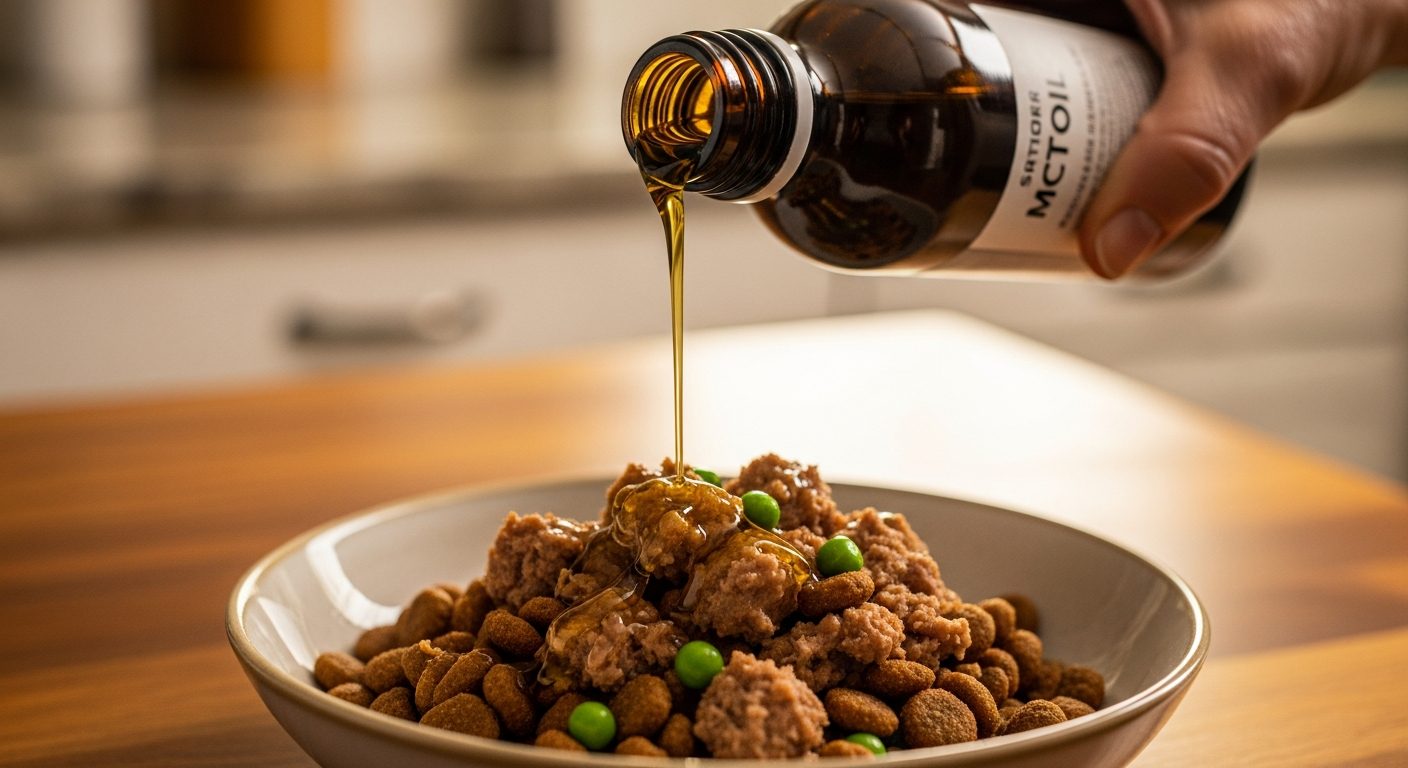
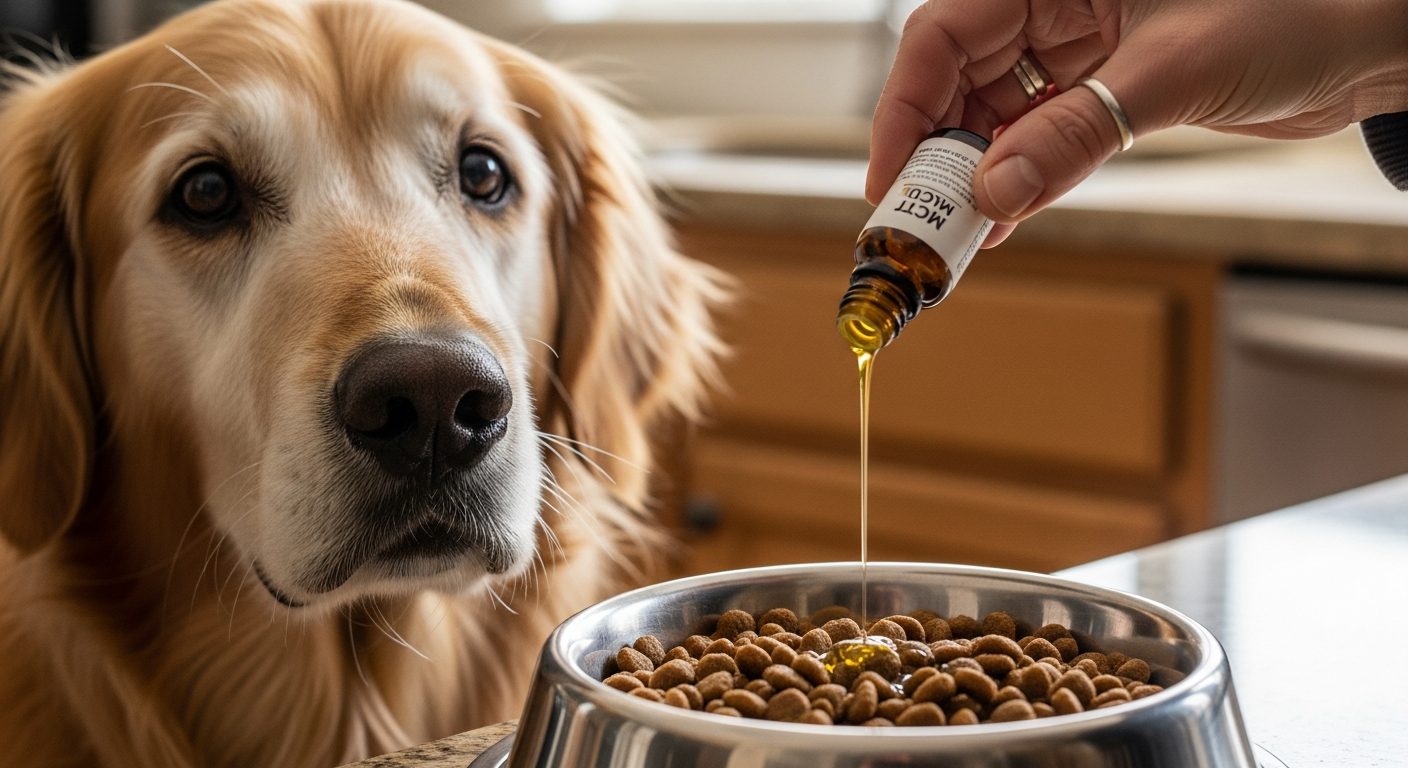
Topper #3: A Drizzle of MCT Oil
- Why: Even if your kibble contains MCTs, adding extra ensures therapeutic levels.
- How: Start with 1/4 teaspoon and slowly work up. Drizzle over kibble and mix.
Part 5: The Hydration Factor
Senior dogs often forget to drink water. A dehydrated brain is a sluggish brain.
If your dog isn't drinking enough:
- Add warm water or low-sodium bone broth to their kibble
- Offer ice cubes as treats
- Use a pet water fountain (the movement attracts their attention)
Part 6: What I Wish I Had Known (The Confession)
I need to admit something. For years, I fed my dog "bacon strip" treats. The first ingredient was corn syrup. The second was wheat flour.
I didn't know better. I thought because he loved them, they were good for him.
Now, knowing what I know about inflammation and "brain rust," I look back at those bags of sugar-treats with regret. I can't change the past, and neither can you. Don't beat yourself up.
But starting today, look at the back of the treat bag.
- If the first ingredient is Sugar, Corn Syrup, or Molasses: Throw it away.
- If it has Red 40 or Yellow 5: Throw it away.
Switch to Single-Ingredient Treats. A piece of dried liver. A dehydrated minnow. A chunk of boiled chicken. Your dog's brain is fighting a war. Don't send in enemy supplies (sugar) while he's trying to defend himself.
FAQ: Common Questions About Feeding a Dementia Dog
Q: Can I just give my dog regular Coconut Oil instead of MCT Oil?
A: You can, but it's less effective. Coconut oil contains MCTs, but it also contains other fats that the liver has to process. Pure MCT Oil (specifically C8 and C10 strains) is like jet fuel—it goes straight to the brain. If you can afford the $25 bottle of MCT, it's worth the upgrade.
Q: My dog has no teeth. Can they eat this?
A: Absolutely. If you use the Bright Mind kibble, add warm water or goat's milk and let it soak for 10 minutes. It turns into a soft mush that is easy to lap up. The sardines and blueberries are already soft enough for gummy seniors.
Q: How long until I see results?
A: This is food, not medicine. It takes time to change cellular biology.
- Energy/Alertness: usually 4-6 weeks.
- Coat/Skin: usually 2-3 weeks.
- Sleep Cycles: varies, but often improves with the addition of MCTs.
Give it at least 60 days before you decide it's not working.
Q: Is "Senior" food the same as "Bright Mind"?
A: No. Most "Senior" foods just lower the calories (because old dogs get fat) and add a little Glucosamine for joints. "Cognitive" foods like Bright Mind have a completely different nutrient profile focused on brain lipids (fats). They are not interchangeable.
Summary: The Promise
Standing in that kitchen, watching my dog relearn how to eat, I made him a promise. I promised that I would stop feeding him like a pet, and start feeding him like a patient.
I couldn't stop the dementia. I couldn't rebuild the neurons that had died. But I could make sure that every remaining neuron was swimming in the best fuel possible.
Whether you buy the $4 blueberries or the $80 kibble, the goal is the same: One more good day.