We tend to think of anxiety in pets as loud. We picture a dog barking at thunder, chewing through a doorframe, or pacing until their paws bleed. We expect drama. But cats are different.
As a species that is both a predator and prey, cats are biologically wired to mask weakness. In the wild, showing vulnerability doesn't get you sympathy; it gets you eaten. So, when a house cat is anxious, they don't typically scream for help. They get quiet. They get subtle. They get "weird."
For millions of cat owners, this evolutionary poker face leads to a dangerous misunderstanding. We label them as "grumpy," "aloof," "spiteful," or "just being a cat." In reality, many of these cats are living in a state of chronic, low-grade cortisol poisoning. They aren't mean; they are suffering.
This comprehensive guide is not just a list of symptoms. It is a deep dive into the feline mind. Over the next 3,000 words, we will dismantle the myths of the "moody" cat, explore the invisible wars happening in multi-cat households, and provide a 2026-updated roadmap for treatment—from "catification" to the latest pharmaceutical protocols.
Disclaimer: Reviewed for behavioral and medical accuracy. Always consult your veterinarian to rule out underlying illness.
In This Guide:
- Part 1: The Biology of the Poker Face
- Part 2: The 7 Hidden Signs (The "Silent" Symptoms)
- Part 3: The "Loud" Signs (When It's Too Late)
- Part 4: The Invisible War (Multi-Cat Stress)
- Part 5: The "Zen Cat" Protocol (Environmental Enrichment)
- Part 6: Medical Intervention (The 2026 Protocols)
- Part 7: Case Studies (Real Stories)
- FAQ: Common Questions
Part 1: The Biology of the Poker Face
To help an anxious cat, you first have to forgive them for hiding it from you.
Unlike dogs, who have evolved alongside humans for 30,000 years to be hyper-communicative with us, cats retain much of their wild ancestry. In nature, a stressed cat freezes. They become small. They conserve energy to either fight or flee.
The Cortisol Effect
When a cat is stressed, their body floods with cortisol. In short bursts (like seeing a rival cat outside), this is helpful. It sharpens reflexes. But when that stress becomes chronic—say, from a toddler who chases them or a housemate cat who blocks the litter box—the cortisol never drains away.
Recent 2025 research published in Animals confirmed what behaviorists have long suspected: environment dictates biology. The study found that shelter cats in "enriched" environments (hiding spots, vertical space) had half the hair cortisol levels of cats in standard housing.
This means anxiety isn't just a "feeling." It is a physical toxicity that affects their immune system, their digestion, and their lifespan.
Part 2: The 7 Hidden Signs (The "Silent" Symptoms)
If you've ever looked at your cat and felt like something was just off—but couldn't put your finger on it—this section is for you. These are the subtle whispers of stress that fly under the radar of even the most loving owners.
1. The "Guarded Meatloaf" (vs. The Relaxed Loaf)
Every cat owner knows the "meatloaf"—when a cat tucks their paws under their chest and sits like a loaf of bread. We assume this means they are relaxing. But look closer.
- The Relaxed Loaf: Head is drooping slightly, eyes are soft or half-closed (slow blinking), ears are neutral. They look like a puddle.
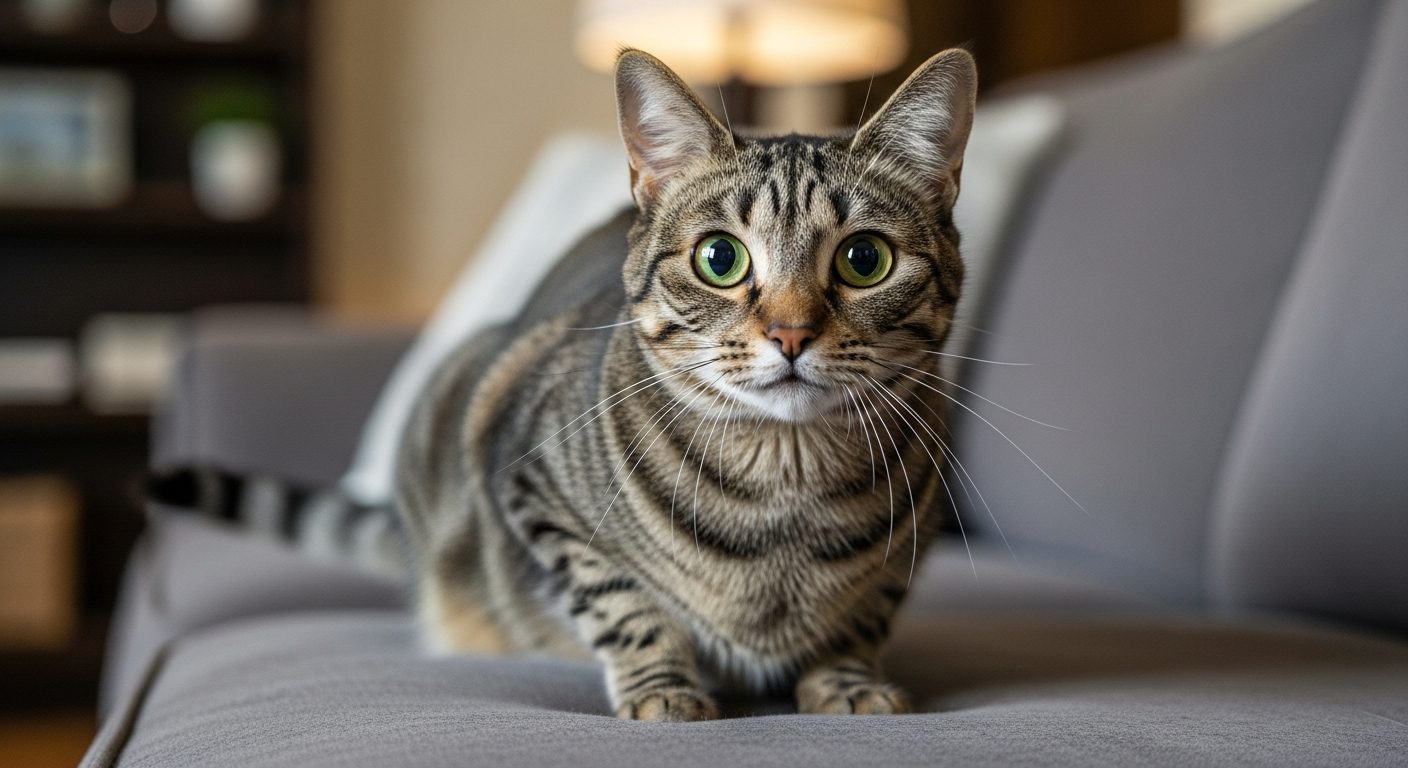
- The Guarded Loaf: The head is held high and stiff. The ears are swiveling like radar dishes (scanning). The eyes are wide and dilated ("saucer eyes").
The Anxiety Tell: In the "Guarded Loaf," the paws aren't fully tucked; they are poised to spring. The cat is pretending to rest, but physically, they are ready to run. This is a sign of hyper-vigilance.
2. The "Zoomies" That Don't Look Like Play
We usually laugh when our cats get the "zoomies" (running frantically from room to room). Usually, this is just pent-up energy. But sometimes, it's panic.
How to tell the difference:
- Play Zoomies: The tail is up or hooked like a question mark. They might pause to look at you. They are engaging with toys.
- Stress Zoomies: The tail is puffed (piloerection) or clamped down. The ears are pinned back. They seem to be running away from something invisible rather than running towards fun.
If your cat consistently has frantic zoomies immediately after using the litter box, this is often a sign of pain (UTI) or anxiety that they felt vulnerable while doing their business.
3. The "Picky Eater" (Social Anorexia)
"Oh, she's just a diva. She only eats if I stand next to her."
This isn't diva behavior; it's Social Eating, and it's a massive red flag for insecurity. In the wild, eating is dangerous. You have to put your head down and stop scanning for predators.
If your cat refuses to eat unless you guard them (or refuses to eat when guests are over), they don't feel safe in their environment. They rely on you to be their "bodyguard" so they can lower their defenses enough to swallow.
4. The Bald Belly (Psychogenic Alopecia)
You notice your cat's belly is thinning. Maybe their inner thighs look bare. You assume it's fleas or a food allergy.
While you should always check with a vet, this pattern is often Psychogenic Alopecia—stress grooming. Licking releases endorphins (nature's painkiller) in a cat's brain. When a cat is chronically anxious, they groom themselves obsessively to self-soothe, similar to a human biting their nails.
The Tell: Unlike flea bites (which are itchy and erratic), stress grooming is usually symmetrical. It happens in easy-to-reach places like the belly, groin, and front legs.
5. The "Velcro" Cat (or The Ghost)
A sudden change in social distance is a major distress signal.
- The Ghost: A formerly social cat who now spends 18 hours a day under the bed or on top of the highest cabinet. They are seeking vertical safety because the floor feels dangerous.
- The Velcro: A formerly independent cat who suddenly cannot be alone. They follow you room to room, weave between your legs, and vocalize if you close a door. This is often triggered by changes in the home (new baby, new schedule) that have shattered their sense of routine.
6. Ripple Skin Syndrome (Feline Hyperesthesia)
Have you ever touched your cat's lower back, and their skin rippled or twitched violently? Did they suddenly bite your hand or lick their back frantically?
This can be a sign of Feline Hyperesthesia Syndrome (FHS), a condition linked to both neurology and high stress. The cat's nervous system is so wound up that a simple touch feels like an electric shock. While this requires veterinary diagnosis, it is almost always exacerbated by environmental stress.
7. Litter Box "Perching"
If your cat uses the litter box but stands on the very edge (perching on the plastic rim like a bird) rather than stepping into the litter, they are telling you they are uncomfortable.
This could be medical (painful paws due to declawing arthritis), but often it is anxiety about entrapment. They don't want to be "caught" inside the box. They are keeping their feet ready to flee. This is common in multi-cat households where one cat bullies another near the bathroom.
Part 3: The "Loud" Signs (When It's Too Late)
If the subtle signs are ignored, the anxiety eventually boils over into "bad behavior."
Urine Marking vs. Toileting
Nothing gets a cat surrendered to a shelter faster than pee. But you must distinguish between the two types:
- Toileting: Squatting to pee on a soft surface (like your bed or a pile of laundry). This is usually an attempt to find a location that feels safer or less painful than the litter box.
- Marking: Standing up, vibrating the tail, and spraying a vertical surface (like a wall or doorframe). This is a territorial shout. The cat is essentially putting up a "Keep Out" sign because they feel their territory is threatened.
Aggression (The "Mean" Cat)
Anxiety aggression is almost always defensive.
- The Hiss: This is not a threat; it is a warning. It means "I am afraid, please back up."
- Redirected Aggression: Your cat sees a stray cat outside the window. They get flooded with adrenaline but can't reach the intruder. You walk by and touch them, and they explode on you. They didn't mean to hurt you; they were chemically primed for a fight.
Part 4: The Invisible War (Multi-Cat Stress)
If you have more than one cat, this is likely the source of your problem. Cats are not naturally pack animals. They can learn to coexist, but often they merely "tolerate" each other in a cold war.
The Art of "Blocking"
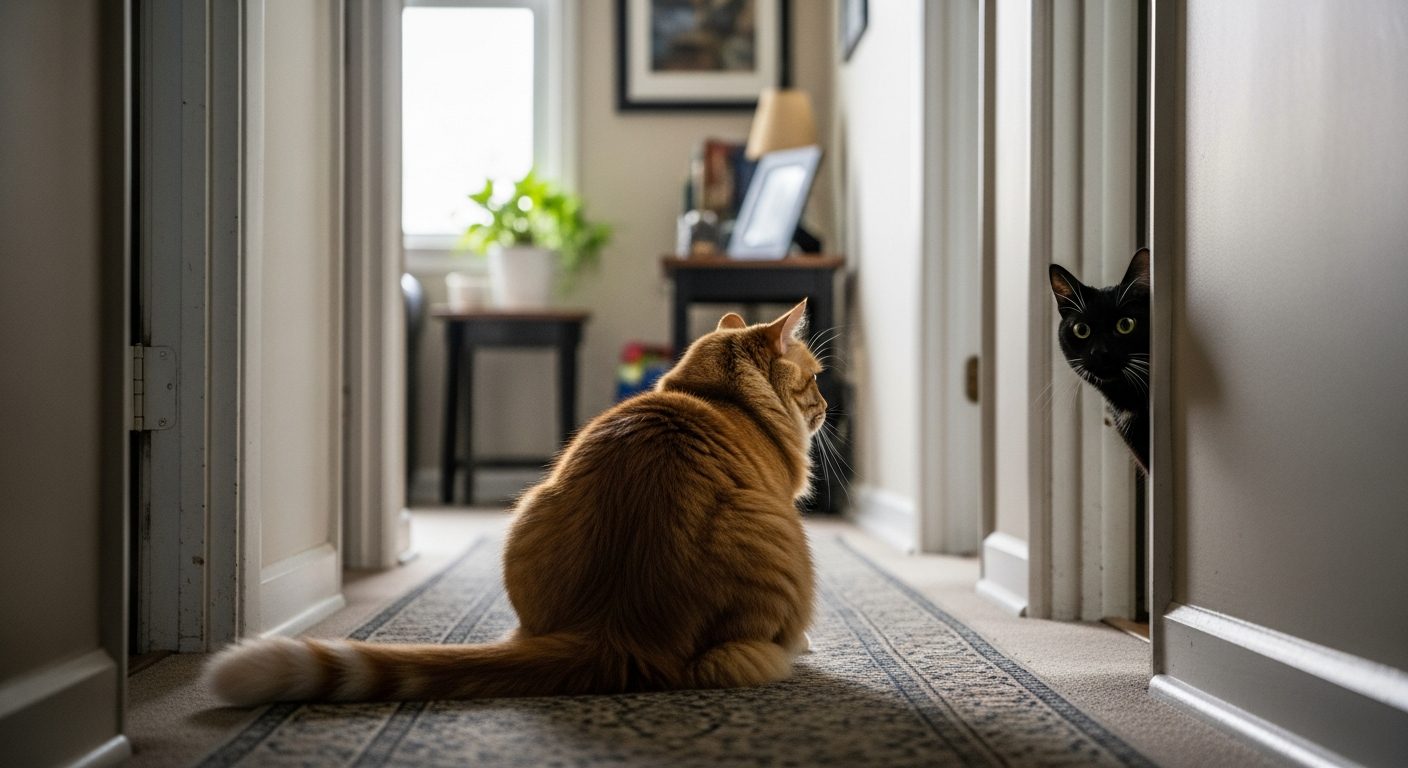
Physical fights are rare. The real war is fought with body language. Watch your cats in a hallway. Does one cat simply lay down in the middle of the hall? To you, it looks like a nap. To the victim cat, it is a Blockade. The aggressor is passively controlling movement, preventing the other cat from accessing the food bowl or litter box without permission.
The Stare
Anxious cats rarely blink. If you catch one cat staring fixedly at another from across the room, that is an act of aggression. The victim cat will often look away, groom nervously, or slowly back out of the room.
Resource Guarding
Does one cat always race to the food bowl first? Does one cat sleep on the bed while the other sleeps on the floor? This isn't just preference; it's a hierarchy of resources. If you don't have enough "stuff" (bowls, beds, boxes) for everyone, you are creating a Lord of the Flies scenario in your living room.
Part 5: The "Zen Cat" Protocol (Environmental Enrichment)
So, how do we fix it? Before you reach for pills, you must fix the environment. In 2026, we call this "Catification."
1. The Superhighway (Vertical Space)
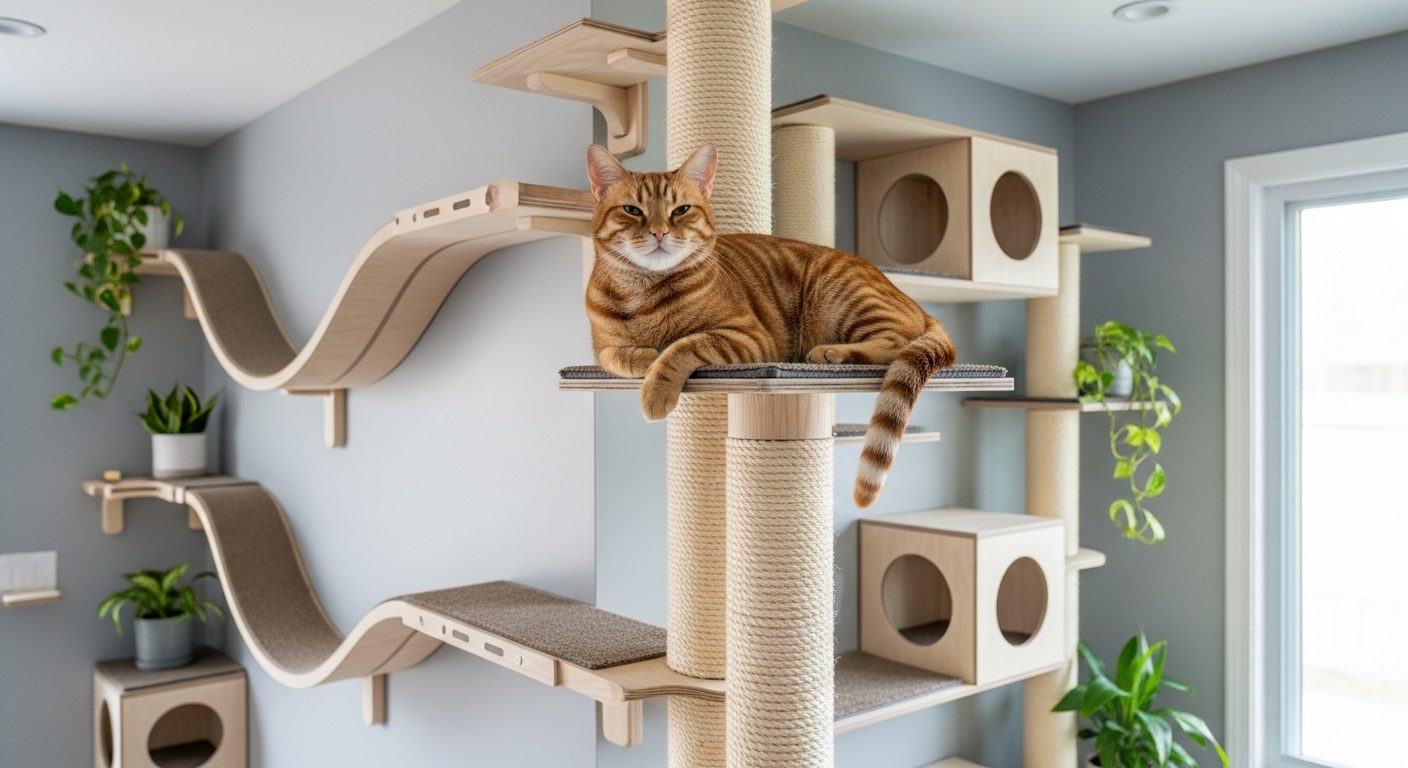
Anxious cats need to survey their world from above.
- The Fix: Install cat shelves, clear off the tops of bookcases, or buy tall cat trees.
- The Rule: A cat should be able to cross a room without touching the floor. This "Superhighway" allows them to navigate around dogs, kids, or other cats without conflict.
2. Scent Soakers
Cats live in a world of smell. They feel confident when their house smells like them.
- The Fix: Place scratchers (cardboard or sisal) in high-traffic areas, like the corners of the sofa or near doorways. When they scratch, they deposit pheromones from their paws, claiming the space.
- The Tool: Use Feliway Classic diffusers. These release a synthetic copy of the "happy" facial pheromone cats leave when they rub their cheeks on things.
3. The "Boil and Simmer" Play Method
A tired cat is a calm cat. But you have to play correctly to drain the cortisol.
- The Boil: Use a wand toy (like Da Bird) to get them panting. Mimic prey—make it hide, scurry, and fly.
- The Simmer: Slow the movement down. Let them catch it.
- The Meal: Feed them immediately after play. This completes the Hunt-Catch-Kill-Eat predatory cycle, triggering a massive release of dopamine and serotonin. Ideally, do this 1 hour before bed to cure nighttime anxiety.
4. The Rule of "N+1"
For litter boxes, you need one per cat, plus one extra.
- 2 Cats = 3 Boxes.
- Location Matters: Do not put them all in the same room. That counts as one "toileting zone." Spread them out so a bully cat cannot guard all bathrooms at once.
Part 6: Medical Intervention (The 2026 Protocols)
Sometimes, enrichment isn't enough. If your cat is self-mutilating, attacking you, or hiding 24/7, their brain chemistry needs a reset.
Do not fear medication. It is not about "zombie-fying" your cat; it is about lowering the panic threshold so they can learn to be happy again.
Gabapentin (The "Spot Treatment")
- Best For: Situational anxiety (Vet visits, car rides, fireworks, guests).
- How it Works: It is a mild sedative and pain reliever.
- 2026 Insight: Vets are increasingly using Gabapentin as a "bridge" medication while waiting for long-term meds to kick in.
- Side Effects: Wobbliness (ataxia) and sleepiness.
Fluoxetine (Prozac)
- Best For: Chronic, generalized anxiety, aggression, and urine marking.
- How it Works: An SSRI (Selective Serotonin Reuptake Inhibitor) that boosts mood-stabilizing chemicals.
- The Timeline: It takes 4 to 6 weeks to work. You cannot give it "as needed."
- The "Jitters": In the first week, some cats get more anxious or lose their appetite. This usually passes.
Pregabalin (Bonqat)
- The Newcomer: Recently FDA-approved for alleviation of acute anxiety and fear associated with transportation and veterinary visits.
- Why use it? It's a liquid, making it easier to dose than pills for many owners.
Part 7: Case Studies (Real Stories)
Case Study 1: The "Phantom Pee-er"
- The Patient: Luna, a 6-year-old Calico.
- The Symptom: Peeing on the owner's laundry pile once a week.
- The Misdiagnosis: "She's mad because I worked late."
- The Reality: Luna had mild arthritis in her hips (diagnosed via X-ray). The litter box had a high rim that hurt to step over. The laundry was soft and on the floor.
- The Fix: A low-entry senior litter box and a course of Solensia (pain medication). The peeing stopped instantly.
Case Study 2: The Aggressive Cuddler
- The Patient: Milo, a 2-year-old Orange Tabby.
- The Symptom: Would sit on laps purring, then suddenly bite the hand petting him.
- The Reality: Overstimulation aggression. Milo had a low tolerance for touch.
- The Fix: The owner learned to watch for the "tail twitch." They stopped petting before he reacted. They added two 15-minute play sessions a day to burn off his hunting energy. The biting reduced by 90%.
Frequently Asked Questions (FAQ)
Q: Can I use CBD for my cat?
A: Proceed with caution. While anecdotal evidence is strong, the veterinary data is still catching up. If you choose CBD, ensure it is THC-Free and third-party tested. Cats are incredibly sensitive to toxins.
Q: Will getting another cat help my anxious cat?
A: Rarely. Bringing a strange cat into the territory of an insecure cat usually pours gasoline on the fire. Fix the anxiety first before even considering a second pet.
Q: Why does my cat yowl at night?
A: In seniors (11+), this is often Cognitive Dysfunction (dementia) or hearing loss. They wake up confused and cry for reassurance. A nightlight and a heated bed can help.
The ZenPet Scorecard: How Stressed is Your Cat?
Give your cat 1 point for each sign observed in the last month:
- ☐ Guarded "Meatloaf" posture
- ☐ Excessive grooming (bald spots)
- ☐ Hiding when guests arrive
- ☐ "Perching" on the litter box
- ☐ Tail twitching while being petted
- ☐ Zoomies immediately after using the litter box
- ☐ Freezing/staring at other household pets
Score 0-1: Zen Cat.
Score 2-3: Mild Anxiety. Try environmental enrichment (Part 5).
Score 4+: High Anxiety. Consult your vet about medication and a behavior plan.
Automatic Self-Cleaning Litter Box
Tired of scooping? This top-rated self-cleaning litter box keeps your home fresh and your cat happy — no daily maintenance required.
Check Price on Amazon →Multi-Level Modern Cat Tree
Elevate your cat's world with this stunning multi-level cat tree. Features multiple perches, scratching posts, and cozy hideaways your cat will love.
Check Price on Amazon →Conclusion
Anxiety is not a character flaw. It is a biological response to a world that feels unsafe.
By learning to read the subtle language of the "Guarded Loaf" or the "Blocked Hallway," you become more than just an owner; you become an advocate. You stop blaming your cat for being "moody" and start building a world where they can finally exhale.
And there is no greater feeling than watching a chronically anxious cat finally flop onto their side, expose their belly, and close their eyes in deep, trusting sleep.
Sources & Further Reading
- Hallo, A., et al. (2025). "The Impact of Environmental Enrichment on the Cortisol Level of Shelter Cats." Animals (Basel). DOI: 10.3390/ani14091392
- Cornell University College of Veterinary Medicine. (2024). "Feline Behavior Problems: Aggression and Anxiety Protocols."
- Tynes, V. V. (2018). "Feline Anxiety and Fear: Clinical Signs and Treatment." Veterinary Medicine.
- Waisglass, S., et al. (2023). "Is it really psychogenic alopecia? A diagnostic review." Journal of Feline Medicine and Surgery.